

SMSF Trustee Education Course
Secure your spot for $11 (once-off). After payment, we’ll email your login and unlock all lessons and the certificate.
You’re viewing a locked lesson preview. Purchase unlocks all 8 lessons, quizzes and the certificate.
The Sole Purpose Test
The sole purpose test is a fundamental requirement for all SMSFs. It mandates that an SMSF must be maintained solely to provide retirement benefits to its members or their dependents in the event of the member’s death. This test ensures that SMSFs are used for their intended purpose and not for personal gain or other unrelated objectives.
Core Purposes
The core purposes of an SMSF, as outlined by the sole purpose test, are:
|
Purpose |
Description |
|
Providing retirement benefits |
To members upon reaching retirement age |
|
Providing benefits upon reaching a prescribed age |
Upon reaching preservation age |
|
Providing death benefits |
To dependents or legal representatives of deceased members |
These core purposes form the foundation of an SMSF’s reason for existence and must be the primary focus of all trustee decisions and actions.
Ancillary Purposes
In addition to the core purposes, the sole purpose test allows for certain ancillary purposes:
|
Purpose |
Description |
|
Termination of employment benefits |
Upon member’s job termination |
|
Ill health or disability benefits |
For members facing severe health issues or disabilities |
These ancillary purposes provide additional flexibility for SMSFs to support members in specific circumstances while still adhering to the sole purpose test.
Breach Indicators
To ensure compliance with the sole purpose test, trustees must be aware of potential breach indicators:
- Seeking benefits outside the sole purpose:
- Using SMSF funds for personal expenses or investments unrelated to providing retirement benefits.
- Providing loans or financial assistance to members or their relatives for purposes unrelated to retirement.
- Decisions influenced by personal advantages:
- Making investment decisions based on personal gain rather than the best interests of the fund and its members.
- Engaging in transactions with related parties that provide an unfair advantage to the trustee or a member.
- Incurring unrelated costs:
- Charging expenses to the SMSF that are not directly related to the fund’s sole purpose.
- Using SMSF assets for personal use or enjoyment without proper compensation to the fund.
Example 1: Using SMSF Funds for Personal Expenses
Scenario: A trustee uses SMSF funds to pay for a personal holiday.
Breach: This use of SMSF funds for personal expenses is a clear violation of the sole purpose test, as the funds are not being used to provide retirement benefits to members.
Consequences of Breaching the Sole Purpose Test
Breaching the sole purpose test can result in severe consequences for both the SMSF and its trustees:
- Loss of tax concessions and complying status for the SMSF
- Significant penalties and fines for trustees
- Potential disqualification as a trustee
- Reputational damage and loss of trust among members
Compliance with the Sole Purpose Test
To maintain compliance with the sole purpose test, trustees must:
- Make every investment and expenditure decision with the sole aim of providing retirement or death benefits to members.
- Keep fund assets entirely separate from personal and business assets, with no personal use or enjoyment of fund assets.
- Transact with related parties only where the law allows and always on arm’s length (commercial) terms.
- Never lend fund money or provide financial assistance to members or their relatives.
- Document the retirement purpose behind investment decisions in minutes and the investment strategy.
- Review arrangements regularly (e.g. at annual audit time) to confirm no member is receiving a present-day benefit.
By understanding and strictly adhering to the sole purpose test, SMSF trustees can ensure that their fund remains compliant, avoids penalties and ultimately achieves its primary goal of providing retirement benefits to its members.
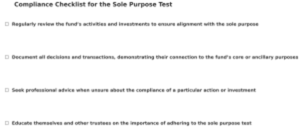
Table Summary of Sole Purpose Breaches
|
Scenario |
Breach Description |
|
Using SMSF funds for personal holiday |
Funds used for personal expenses, not for retirement benefits |
|
Lending SMSF money to a relative |
Providing financial assistance for non-retirement purposes |
|
Personal use of SMSF-purchased holiday home |
Using SMSF assets for personal enjoyment |
|
Selling asset to SMSF at an inflated price |
Engaging in non-arm’s length transactions for personal financial benefit |
|
Charging SMSF for personal travel expenses |
Incurring unrelated costs not directly related to the fund’s sole purpose |
Additional Resources
- ATO – The Sole Purpose Test: ATO Sole Purpose Test
- ASIC – SMSF: The Sole Purpose Test: ASIC Sole Purpose Test
Finish Course Early?
You have not completed all required lessons and assessments.