

SMSF Trustee Education Course
Secure your spot for $11 (once-off). After payment, we’ll email your login and unlock all lessons and the certificate.
You’re viewing a locked lesson preview. Purchase unlocks all 8 lessons, quizzes and the certificate.
SMSF Investment Rules ( what can you invest in)
Introduction
As an SMSF trustee, it is important to understand the investment rules set by the super laws (SIS Act 1993). These rules are in place to protect fund members and ensure SMSFs are used properly for retirement savings. In this lesson, we’ll go over the main investment restrictions regarding acquisitions, investments, borrowings, loans and arm’s-length dealings.
Acquisitions from Related Parties
SMSFs are generally prohibited from acquiring assets from related parties, such as members, trustees, or their associates (SIS Act, Section 66). There are some exceptions to this rule, including:
|
Type |
Description |
|
Listed Securities |
(e.g., shares, units, bonds) acquired at market value |
|
Business Real Property |
Acquired at market value |
|
In-House Assets |
(e.g., shares in a related company) that do not exceed 5% of the fund’s total assets |
|
Certain Investments |
In related non-geared unit trusts or companies |
In-House Asset Rules
In-house assets are investments in, or loans to, related parties of the fund (SIS Act, Section 71). SMSFs must limit in-house assets to no more than 5% of the fund’s total assets at market value (SIS Act, Section 82). Trustees must regularly monitor and ensure compliance with this limit.
Sole Purpose Test
All investments made by an SMSF must satisfy the sole purpose test (SIS Act, Section 62), which means they must be made for the sole purpose of providing retirement benefits to members or their dependents. Investments that provide personal benefits to members or their associates may breach the sole purpose test.
Arm’s-Length Dealings
All investments and transactions made by an SMSF must be conducted on an arm’s-length basis (SIS Act, Section 109). This means that the terms and conditions of the transaction must be the same as those that would apply between unrelated parties. Non-arm’s-length income (NALI) is taxed at the highest marginal tax rate (45% as of 2026-27).
Borrowing Restrictions
SMSFs are generally prohibited from borrowing money (SIS Act, Section 67). However, there are some exceptions, such as:
- Limited Recourse Borrowing Arrangements (LRBAs): for the purchase of a single asset (e.g., property) (SIS Act, Section 67A)
- Short-Term Borrowings: to cover settlement of securities transactions or to pay superannuation benefits (must not exceed 10% of the fund’s total assets) (SIS Act, Section 67)
- Borrowings under Specific Instalment Warrant Arrangements: (SIS Act, Section 67)
Loan Restrictions
SMSFs are prohibited from lending money or providing financial assistance to members or their relatives (SIS Act, Section 65). This includes using fund assets as security for personal loans.
Collectibles and Personal Use Assets
There are specific rules governing the acquisition, storage and insurance of collectibles and personal use assets (e.g., artwork, jewelry, wine, vehicles) (SIS Regulations, Regulation 13.18AA). These assets must be:
- Acquired for Market Value: from an unrelated party
- Stored Separately: from the personal assets of members and related parties
- Insured in the Name of the SMSF: within seven days of acquisition
- Not Used: by members or related parties
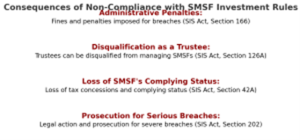
Consequences of Non-Compliance
Additional Resources
- ATO – SMSF investment rules: https://www.ato.gov.au/super/self-managed-super-funds/investing/investment-rules/
- ASIC – SMSF investing: https://www.moneysmart.gov.au/superannuation-and-retirement/self-managed-super-fund-smsf/smsf-investing
- Superannuation Industry (Supervision) Act 1993: https://www.legislation.gov.au/Details/C2021C00026
Finish Course Early?
You have not completed all required lessons and assessments.