

SMSF cryptocurrency investments: Opportunities and Risks Contents Introduction Understanding Cryptocurrencies Opportunities of Cryptocurrency in SMSFs Risks of Cryptocurrency Investments SMSF Trustee Compliance & Considerations Required Reporting Documents for SMSF Crypto FAQs Conclusion Disclaimer Introduction SMSF cryptocurrency investments have evolved from fringe innovation to a globally recognised asset class. With Bitcoin, Ethereum and other digital assets […]
SMSF cryptocurrency investments: Opportunities and Risks
Contents
Introduction
SMSF cryptocurrency investments have evolved from fringe innovation to a globally recognised asset class. With Bitcoin, Ethereum and other digital assets rising in popularity, Self-Managed Super Fund (SMSF) trustees and members are exploring the potential benefits and risks of adding crypto to their portfolios. At My SMSF, we’ve supported SMSF investors since 2016 to help them manage crypto in their super fund.
Understanding Cryptocurrencies
SMSF cryptocurrency investments are decentralised digital assets secured by cryptography and typically powered by blockchain technology. They are not controlled by a central authority, making them both attractive and complex for investors.
Key Features of Cryptocurrencies
| Feature | Description |
|---|---|
| Blockchain | Distributed ledger that ensures transparency and immutability |
| Security | Encryption and decentralisation offer strong resistance to tampering |
| Volatility | Prices can fluctuate sharply, impacting gains or losses |
| Storage | Requires a private key, with options for hot or cold wallet storage |
| Regulation | Varies by jurisdiction and may impact SMSF compliance |
Opportunities of Cryptocurrency in SMSFs
Why SMSFs Are Investing in Crypto
| Benefit | Explanation |
|---|---|
| High Growth Potential | Bitcoin has risen from <$1,000 in 2013 to over $100,000 AUD in recent peaks |
| Diversification | Low correlation with traditional assets like shares or property |
| Transparency | Public blockchain ledgers support traceable transactions |
| Pension Phase Advantage | Potential tax-free gains in pension phase under current ATO rules |
Risks of Cryptocurrency Investments
Despite attractive returns, SMSF cryptocurrency investment can expose trustees to significant risk if not properly managed.
Key Risks to Watch
| Risk Factor | Details |
|---|---|
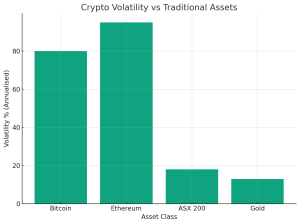
| Extreme Volatility | Sudden price drops may cause capital loss |
| Regulatory Uncertainty | Regulatory changes could restrict crypto use within SMSFs |
| Custodial Risk | Lost private keys = lost funds. Third-party exchange wallets may pose counterparty risks |
| Centralised Token Risks | Coins like Terra (LUNA) collapsed due to flawed mechanics and poor transparency |
| Security Breaches | Centralised coins and exchanges have historically been targeted by hackers |
Chart: Crypto Volatility Compared to Traditional Assets
SMSF Trustee Compliance & Considerations
Trustees must ensure any crypto investment meets the ATO’s compliance framework.
Trustee Action Checklist
| Action | Requirement |
|---|---|
| Update Investment Strategy | Must reference crypto investments and risk tolerance |
| Review Trust Deed | Ensure it permits crypto as an allowable asset |
| Audit-Ready Documentation | Maintain receipts, valuations and transaction logs |
| Secure Storage | Cold wallet recommended. Exchange wallets must be secure and reputable |
| Track Valuation at 30 June | Use services like CoinMarketCap or CoinGecko |
Required Reporting Documents for SMSF Crypto
To comply with SMSF annual audit and reporting obligations, gather:
| Document Type | Description |
|---|---|
| Transaction Report | Complete trade list for the financial year |
| Buy/Sell Receipts | Contract notes or exchange confirmations |
| 30 June Valuation | Screenshot or report from reliable crypto price aggregator |
| Wallet Screenshot | Especially for cold wallet holdings with identifiable date |
Update the Investment Strategy and Deed:
SMSF cryptocurrency investment must ensure that the fund’s investment strategy should detail the approach to cryptocurrency investments and how they fit within the overall investment strategy and risk profile of the fund. Check that your super fund deed allows investment in crypto assets, as many deeds still do not. Annual Reporting: if you hold crypto assets in an self managed super fund ( SMSF) you will need to provide your accountant or provider with the following documents:
- Transaction report – for all trades in the financial year
- Buy/Sell/Swap/Shape – receipts or contract notes
- Value your Crypto Assets – you can do this by getting the values of coins from any online reporting service like www.coinmarketcap.com and obtain the value of the coin/s on the 30th of June of each year.
Security Measures: Have robust security measures in place to protect the fund’s assets. This includes secure storage of cryptocurrency in cold wallets and separate private key management strategies or failing this, using a reputable, well established local coin exchanges exchange wallet which makes reporting and management easier.
Valuation Concerns: The volatile nature of cryptocurrencies means their value can change quickly and dramatically.
Cryptocurrencies present a fascinating opportunity for SMSFs, offering potential for high returns and portfolio diversification and potentially tax free capital gains in the pension phase for many Australians. However, they also come with significant risks such as volatility and provider risks that most Australians might not be aware of. Super fund members, must carefully consider these risks, ensure regulatory compliance and appropriately manage and monitor the fund’s cryptocurrency investments. As always, it is wise to seek professional tax, crypto and legal advice when embarking on crypto investing in an SMSF.
FAQs
1. Can I use an Cold wallet for my SMSF crypto?
Yes, but it’s recommended to use Australian-based, reputable exchange wallet for the simplicity of SMSF tax work and auditing. Online exchanges offering a Exchange wallet offer transparent reporting. Cold wallets are more secure and offer offline storage, but it will require a lot more information and proofs at tax and audit time.
2. Is investing in crypto legal for SMSFs?
Yes, as long as it complies with your SMSF’s trust deed and the ATO’s guidelines. It must meet the sole purpose test and be properly documented.
🔗 ATO: SMSFs and cryptocurrency
3. What are the top coins SMSFs invest in?
At My SMSF, we observe that over 70% of our clients invest primarily in:
-
Bitcoin (BTC)
-
Ethereum (ETH)
-
Solana (SOL)
These are typically preferred due to their market capitalisation and liquidity.
Conclusion
Cryptocurrency offers SMSFs a compelling combination of growth potential, diversification and innovation. However, this comes with regulatory obligations and risks that must be carefully managed. With proper strategy, professional support and disciplined security protocols, crypto can be a valuable addition to a self-managed super portfolio.
If you’re considering crypto for your SMSF, talk to the experts at MySMSF—we’ve helped hundreds of trustees invest in crypto with compliance, tax reporting and ATO-auditor readiness in mind.
Disclaimer
This article is general information only and does not constitute financial, tax, or legal advice. Always consult a licensed financial advisor or SMSF specialist before making investment decisions within your fund. Cryptocurrency investments carry risk and may not be suitable for all SMSFs or members.