

My SMSF Budget Review 2026: What the Tax Reforms Mean for Property, Trusts and Your Super Table of Contents At a Glance: What’s Changing Negative Gearing — Established Property Investors Caught Out CGT Changes — The Detail Matters More Than the Headline Family Trusts and the Bucket Company Problem What This Means If You Have […]
My SMSF Budget Review 2026: What the Tax Reforms Mean for Property, Trusts and Your Super
Table of Contents
The 2026 Federal Budget has delivered some of the most significant proposed tax reforms Australian investors have seen in more than two decades. If you are an SMSF trustee, property investor, or someone using a family trust structure, these changes deserve your full attention not just as headlines, but in terms of how they affect your specific structure.
As I have written about in previous articles on SMSF pension strategies and assets held inside super funds, the real power of an SMSF lies in its tax environment. Interestingly, what this Budget does almost inadvertently is make the SMSF structure look significantly more attractive compared to personal and trust ownership of investment assets.
Let me break down what the Government is actually proposing and what it means in practice.
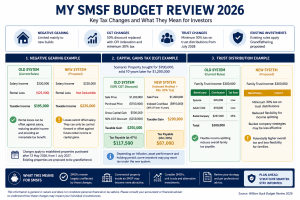
At a Glance: What’s Changing {#at-a-glance}
Negative Gearing — Established Property Investors Caught Out {#negative-gearing}
The cut-off date has already passed. If you purchased or were under contract for an established residential property before 7:30pm on 12 May 2026, the existing rules continue to apply until you sell. However, for any established residential property you purchase after that date, you can no longer offset negative gearing losses against salary or other personal income from 1 July 2027.
Instead, you must either:
-
Offset losses against residential rental income from other rental properties
-
Offset losses against capital gains when you eventually sell the property
-
Carry them forward to future income years
What Still Qualifies for Negative Gearing
New builds remain fully eligible. Off-the-plan apartments, duplex knock-down rebuilds that increase housing density and new constructions on vacant land all qualify. However, a standard knock-down rebuild of one house replacing another does not qualify. That distinction matters and it will trip up investors who assume any new construction counts.
The Impact on SMSF Trustees
For SMSF trustees specifically, superannuation funds are fully exempt from these negative gearing changes. As a result, commercial property inside your SMSF including business real property continues under its existing tax treatment without disruption.
Example: Old System vs New System
David earns:
-
Salary: $220,000
-
Rental property loss: $25,000
Current Outcome
David reduces his taxable income and receives an immediate tax benefit.
Proposed New System — if David buys an established property after the cut-off date:
The $25,000 loss would instead be carried forward, or only offset against future rental income or capital gains from property.
Record-Keeping Just Got More Complex
William Buck flags that investors will now need to separately track purchase dates, property types and loss pools for each property to maintain correct tax treatment. In other words, it creates a dual-system headache and that makes disciplined record-keeping more essential than ever.
CGT Changes — The Detail Matters More Than the Headline {#cgt-changes}
This is the change that surprised most advisers. Currently, individuals and trusts receive a 50% CGT discount on assets held longer than 12 months. The Government now proposes to replace that flat discount with a CPI indexation method, plus a minimum 30% tax rate on capital gains, effective from 1 July 2027.
Critically, SMSFs are not affected. The tax treatment of capital gains inside superannuation funds is not changing under the current proposals.
Why the “New System Is Cheaper” Claim Doesn’t Always Hold
Current System — Sarah’s Example
Sarah buys an investment property for $700,000 and sells it 10 years later for $1,200,000.
Proposed System — CPI Indexation (30% inflation assumed over 10 years)
When the New System Actually Costs More
In that example, the new system looks better but only because inflation was high relative to nominal growth. For high-growth assets like shares, crypto, or premium residential property in Sydney or Melbourne where prices doubled while inflation ran at 20–25% the old 50% discount system would have produced a lower tax bill. Consequently, the crossover point depends entirely on your asset’s actual growth rate relative to CPI.
Furthermore, there is some grandfathering proposed for gains that have already accrued on assets held before the commencement date. However, the precise mechanics are still being legislated.
Family Trusts and the Bucket Company Problem {#family-trusts}
If you use a discretionary trust whether for income splitting or accumulation through a bucket company the proposed changes from 1 July 2028 will impose a minimum 30% tax on distributions before they reach beneficiaries.
What Specifically Changes
-
Individual beneficiaries receive a non-refundable tax credit for the 30% already paid so they are not double-taxed, but the minimum floor is locked in
-
Corporate beneficiaries do not receive that credit meaning bucket company accumulation strategies could end up worse off overall
-
Primary production income has limited grandfathering; however, most other trust income does not
Example: Current Trust Distribution vs Proposed System
Current Structure — Family Trust Earns $300,000
The family currently reduces overall tax payable significantly through this structure.
Proposed System from July 2028
-
Trust income faces a minimum 30% tax before distribution
-
Trustees lose flexibility to split income to low-tax beneficiaries
-
Bucket company accumulation strategies become materially less effective
For those who have structured rental or investment income through a family trust to split income with a lower-earning spouse or adult children, that flexibility is significantly curtailed under this proposal.
What This Means If You Have an SMSF {#smsf-impact}
If you have been following my articles on SMSF pension planning and concessional contribution strategies, the key takeaway from this Budget is straightforward: the relative attractiveness of the SMSF structure has increased considerably.
Strategies Worth Reviewing Right Now
-
Commercial property inside your SMSF becomes more compelling than ever — exempt from negative gearing changes, taxed at 15% (0% in pension phase) and unaffected by CGT reform
-
Residential property inside an SMSF remains one of the most tax-effective ways to hold property — concessional super contributions, rental income and interest are all taxed at 15%, resulting in faster loan repayment without impacting your lifestyle income the way personal borrowing does
-
The one-third CGT discount inside super remains unchanged — your fund’s existing concession on assets held longer than 12 months continues without interruption
-
Accelerating contributions before pension phase becomes an even stronger strategy for those approaching retirement, as it crystallises a low-tax environment for future gains
-
0% tax in pension phase — with up to $2.1 million per person under the transfer balance cap (with Division 296 adding an extra tax on total super balances above $2.1 million per person under the transfer balance cap (Division 296 applies an additional tax above $3 million per person)) and up to six members allowed in a single SMSF, the fund also works as a powerful succession planning vehicle
Industry Reaction and the Political Outlook {#industry-reaction}
These proposals still require legislation and political passage. The reforms have already drawn strong criticism from property industry groups concerned about rental supply contraction and equally strong praise from housing affordability advocates. Whether the trust and CGT measures survive intact or face amendment during Senate debate remains uncertain, though Labor’s landslide second-term majority gives the Government considerably more runway than in previous terms.
Dan Miles from Innova Asset Management noted that for super funds specifically, the budget is relatively benign. No new superannuation changes were announced beyond what was already proposed and the existing SMSF framework remains intact.
The Structural Question Has Changed {#structural-question}
The 2026 Budget fundamentally shifts the central planning question away from what to invest in and toward which structure to invest through. Personal ownership of established residential property now represents the least tax-advantaged option for new acquisitions. By contrast, new builds, commercial property and assets inside an SMSF or company structure now carry a meaningful and growing structural advantage.
What Investors Should Review Now
Whether you are building toward retirement or already drawing a pension from your SMSF, now is the right time to model how your current ownership structure stacks up under the proposed rules and whether repositioning before 1 July 2027 makes sense for your situation.
As always, your specific circumstances drive the answer. Tax outcomes depend on your marginal rate, asset mix, holding period and long-term goals. Consequently, get qualified advice before making any structural changes.
Frequently Asked Questions {#faqs}
Q1: Does my existing investment property lose its negative gearing deductions?
No — provided you owned or held a binding contract for the property before 7:30pm AEST on 12 May 2026, your property is grandfathered under the current rules. Therefore, you can continue to offset rental losses against your salary and other income as before. The changes only apply to established residential properties purchased after the Budget night cut-off, with the new rules commencing 1 July 2027.
Q2: Will my SMSF be affected by the CGT and trust distribution changes?
For the most part, no. The Government specifically excludes SMSFs from the proposed negative gearing restrictions and the trust distribution minimum tax rules do not apply to complying superannuation funds. Furthermore, the one-third CGT discount available to SMSFs on assets held longer than 12 months remains unchanged. Your fund’s existing concessional tax environment — 15% on income, 10% on long-term capital gains and 0% in pension phase — is intact under the current proposals.
Q3: Should I rush to restructure my investments before 1 July 2027?
Not necessarily and certainly not without professional advice first. The proposed changes are not yet law — they still require legislation to pass Parliament. That said, the negative gearing grandfathering cut-off has already passed (12 May 2026), so that window is closed. For CGT and trust changes, however, it is worth modelling your specific asset mix, marginal tax rate and holding period now so you are ready to act once legislation is confirmed. Restructuring decisions — particularly those involving SMSFs — also involve contribution caps, stamp duty and other costs that need careful consideration.
General Disclaimer
The information in this article is general in nature and does not take into account your personal objectives, financial situation or needs. It is for educational purposes only and does not constitute financial, tax or legal advice.
The proposed tax reforms discussed here are based on 2026 Federal Budget announcements that are not yet law. Legislative details, commencement dates and eligibility conditions may still change. Therefore, you should not act on any information in this article without first obtaining qualified, independent professional advice tailored to your individual circumstances.
SMSF trustees should be aware that the rules governing self-managed superannuation funds are complex and subject to regulation by both the ATO and APRA. Non-compliance can result in significant penalties. Always consult a licensed tax agent, financial adviser or SMSF specialist before making investment, contribution or structural decisions.
This article reflects information available as at 14th of May 2026. mysmsfproperty.com.au does not accept liability for any loss or damage arising from reliance on this material.
Sources: William Buck Federal Budget 2026 Analysis, ABC News Budget 2026, Innova Asset Management – Dan Miles