

SMSF’s investing in Managed Funds: Capital Loss Ordering Could Be Costing You Thousands Table of Contents The Managed Fund Blind Spot Every SMSF Trustee Has What Actually Happens Inside a Managed Investment Trust The Two-Level Problem: Fund Level vs. Your SMSF Level Why the 2026 Budget Makes This Urgent for ASX Investors The Real-World Impact […]
SMSF’s investing in Managed Funds: Capital Loss Ordering Could Be Costing You Thousands
Table of Contents
- The Managed Fund Blind Spot Every SMSF Trustee Has
- What Actually Happens Inside a Managed Investment Trust
- The Two-Level Problem: Fund Level vs. Your SMSF Level
- Why the 2026 Budget Makes This Urgent for ASX Investors
- The Real-World Impact on Your SMSF Returns
- What You Can Actually Do About It
- The AMIT Curveball Most Trustees Miss
- Frequently Asked Questions
The Managed Fund Blind Spot Every SMSF Trustee Has
If your SMSF holds exchange-traded funds (ETFs), listed investment companies (LICs), property trusts, or any managed fund on the ASX, there is a quiet mechanism working against your after-tax returns and most trustees never see it coming.
It is called capital loss ordering and it governs how losses inside your managed fund are applied before the net gains ever reach your SMSF tax return. The problem? You have almost no visibility into how the fund does it, yet it directly affects how much tax your SMSF pays and, ultimately, how much wealth you keep.
This is not about picking the wrong fund. It is about understanding that the tax outcome of your managed fund investment is not just about what the fund earns it is about how the fund and then your SMSF, applies the losses.
What Actually Happens Inside a Managed Investment Trust
A Managed Investment Trust (MIT) is the legal structure behind most ASX-listed funds everything from broad-market ETFs like VAS and VGS to property trusts and infrastructure funds. Many of these have elected into the Attribution Managed Investment Trust (AMIT) regime, which means the trust “attributes” taxable income to you based on your unit holding, rather than paying tax itself.
Here is what many SMSF investors do not realise: when the fund makes a capital loss, it cannot pass that loss to you. The loss is trapped inside the trust. The fund must carry it forward and use it to offset its own future capital gains before anything is distributed to you.
You only ever see the net result. If the fund had a bad year and realised losses, those losses are working for the fund not necessarily for your SMSF’s specific tax position. You might have capital losses elsewhere in your SMSF that could have been used more strategically, but you do not get that choice. The fund has already done the maths.
The Two-Level Problem: Fund Level vs. Your SMSF Level
The tax treatment of managed fund distributions happens at two levels and most trustees only think about one.
Level One: Inside the Fund
The fund manager decides how to apply capital losses. They offset losses against gains according to the trust deed and tax law, then distribute what is left. You receive an AMMA statement or distribution advice telling you what to report. But you have no say in whether the fund’s internal loss ordering was optimal for your SMSF’s tax position.
Level Two: Inside Your SMSF
Once the distribution hits your SMSF, the real work begins. Your SMSF must apply its own capital loss ordering rules. The ATO requires you to offset current-year capital losses first, then unapplied losses from prior years, then apply the CGT discount.
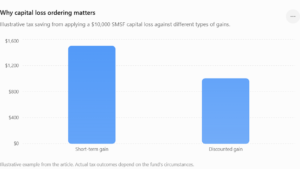
But here is the critical choice: you decide which gains to absorb first. The ATO confirms you will usually get the greatest benefit by applying losses against gains calculated using the ‘other’ method (no discount, short-term) first, then indexation method gains and finally discounted gains last.
Why does this matter? Because SMSFs get a one-third CGT discount on assets held longer than 12 months, reducing the effective tax rate on capital gains to just 10%.
If you burn your losses wiping out gains that were already taxed concessionally, you are wasting the loss. You want to use every dollar of loss to kill off the most heavily taxed gains first.
The Australian has reported that SMSFs have been delivering remarkable returns that outpace both big super funds and retail rivals. As noted in July 2025, while some large funds managed just 9.5 per cent over the year to June, SMSFs were returning figures of 13 per cent, with the sector achieving substantial growth in net assets.
That outperformance makes tax efficiency even more important—every dollar of unnecessary tax is a dollar of compounding growth lost.
Why the 2026 Budget Makes This Urgent for ASX Investors
The 2026–27 Federal Budget delivered a structural shift that should alarm any investor holding managed funds outside super. From 1 July 2027, the 50 per cent CGT discount for individuals, partnerships and trusts will be replaced by cost base indexation and a 30% minimum tax on net capital gains.
The Australian reported extensively on these changes, noting that from July 2027, Labor will replace the current 50 per cent CGT discount on assets held for more than a year with an inflation-linked indexation model.
The housing tax changes are expected to raise $1.35 billion in revenue.
SMSFs are excluded. Complying superannuation funds retain their existing one-third CGT discount and concessional tax rates.
Widely held trusts, including most ASX-listed managed investment trusts, are also carved out from the negative gearing restrictions.
What this means in practice: if you hold the same ETF in your personal name and in your SMSF, the after-tax return gap is about to widen dramatically. The Australian highlighted that investors face a crucial decision as the government moves to scrap the 50 per cent capital gains tax discount, with stockmarket investors needing to understand the implications before the budget hit takes effect.
For SMSF trustees, this is not just a tax story—it is a returns story. The more tax you pay outside super, the less competitive your personal portfolio becomes relative to your SMSF. Capital loss ordering inside your SMSF, done correctly, becomes a genuine edge.
The Real-World Impact on Your SMSF Returns
Let us make this concrete. Imagine your SMSF holds two investments:
- A listed property trust (MIT) that distributes a $10,000 capital gain (already net of the fund’s internal losses)
- A direct share holding you sold at a $10,000 loss
If your SMSF simply nets these against each other, the result is zero tax. But if the property trust distribution included a discounted capital gain (which must be grossed up to $20,000 before the discount is applied),
and your share loss is applied against that grossed-up amount, you might think the loss is fully absorbed. But what if you also had a short-term gain elsewhere?
If you had applied the $10,000 loss against a short-term gain first (taxed at the full 15% SMSF rate), you would have saved $1,500 in tax. By applying it against the discounted gain instead, you only saved the equivalent of $1,000 in tax after the discount. That $500 difference is pure return leakage and it compounds every year you make the wrong choice.
Now multiply that across a portfolio of ETFs, property trusts and direct shares over a decade. The drag on returns is material.
What You Can Actually Do About It
You cannot control how the fund applies its internal losses. But you can control what happens once the distribution lands in your SMSF. Here is what awareness looks like in practice:
- Do Not Just Net Everything Off
When your SMSF annual return is prepared, ask your accountant specifically: which gains did my losses offset? If the answer is “we just netted them,” push for a strategic ordering review.
- Time Your Loss Realisations
If you know your managed funds typically distribute capital gains in June, consider whether you have underperforming direct holdings you could sell before year-end. That gives your SMSF current-year losses to deploy against those distributions.
- Know Your Discounted Distributions
If your AMMA statement shows a discounted capital gain, remember it must be grossed up before you apply losses.
Many trustees understate their total capital gains because they forget this step, which leads to incorrect loss application.
- Track Carried-Forward Losses Religiously
Net capital losses can be carried forward indefinitely in an SMSF.
If your fund has been accumulating losses year after year, make sure they are being deployed against the right gains—not just the convenient ones.
- Check Your Pension Phase Position
If your SMSF has members in retirement phase, assets supporting income streams may qualify for exempt current pension income (ECPI), meaning 0% CGT.
In a mixed-phase SMSF, strategic segregation can reduce or eliminate the tax impact of managed fund distributions entirely.
The AMIT Curveball Most Trustees Miss
If your fund is an AMIT—and most modern ETFs and managed funds are—there is an extra layer of complexity. Under the AMIT regime, your cost base is adjusted every year based on the difference between the cash you received and the taxable income attributed to you.
If the cash distribution is larger than the attributed taxable amount, your cost base goes down. That means when you eventually sell the units, your capital gain will be higher than you expected. If you have been tracking your cost base based only on your purchase price, you are flying blind on what your true future gain—or loss—will be.
This matters because it affects your future capital loss ordering. A lower cost base today means a bigger gain tomorrow, which means you will need more losses to offset it. Trustees who ignore AMIT cost base adjustments are effectively underestimating their future tax liability.
Frequently Asked Questions
Can my SMSF claim a capital loss directly from a managed fund distribution?
No. Managed funds and MITs cannot distribute capital losses to unitholders. Any capital losses realised by the fund are retained internally and used to offset the fund’s own future capital gains. Your SMSF only ever receives the net capital gain, if any, after the fund has applied its losses.
Why does the 2026 Budget make my SMSF’s managed fund holdings more valuable?
From 1 July 2027, individuals, partnerships and discretionary trusts will lose the 50% CGT discount and face a 30% minimum tax on net capital gains. SMSFs are excluded from these changes and retain their one-third CGT discount (effective 10% tax rate on eligible gains).
This means the same ETF or managed fund held inside your SMSF will likely generate a significantly higher after-tax return than an identical holding in your personal name or family trust.
What is the difference between a capital gain distribution and a tax-deferred amount from a managed fund?
A capital gain distribution is assessable income that must be included in your SMSF’s net capital gain calculation and taxed accordingly. A tax-deferred amount (or AMIT cost base adjustment) is not taxed in the year you receive it. Instead, it reduces the cost base of your units, which increases your future capital gain (or reduces your future loss) when you eventually sell.
Tax-deferred amounts are common in property and infrastructure trusts and can create a nasty surprise if you have not been tracking your adjusted cost base.
External Resources
- ATO: Managed Investment Trusts
- ATO: Using Capital Losses to Reduce Capital Gains
- ATO: How SMSFs Are Taxed
- ATO: Personal Investors Guide to Capital Gains Tax
- ATO: Trust Capital Gains and Losses
- https://www.theaustralian.com.au/wealth/investing/what-sharemarket-investors-need-to-know-before-budget-cgt-hit/news-story/f386d1be0283d7d1336e4397dcd3bbf3
- https://www.theaustralian.com.au/wealth/investing/how-the-budget-changes-will-affect-your-investments-and-planning/news-story/ac5e8c79812f9e71a33e6a1ea750e164
- https://www.theaustralian.com.au/wealth/superannuation/smsfs-out-perform-rivals-including-big-super-funds-and-become-a-tax-target-for-albanese-government/news-story/f59c8094caeefcbf2712e4005d97a5ea
This article is for informational purposes only and does not constitute financial or tax advice. SMSF trustees should consult a licensed tax professional or SMSF specialist adviser before making investment or tax decisions.