

SMSFs Have Changed More in 2026 Than Many Trustees Realise — Here’s What to Review Now For many SMSF trustees, 2026 has not felt like a dramatic year. The fund may still hold the same shares, ETFs, property and cash. Contributions continue to arrive. Pensions continue to be paid. The annual tax return still needs […]
SMSFs Have Changed More in 2026 Than Many Trustees Realise — Here’s What to Review Now
For many SMSF trustees, 2026 has not felt like a dramatic year.
The fund may still hold the same shares, ETFs, property and cash. Contributions continue to arrive. Pensions continue to be paid. The annual tax return still needs to be lodged. However, underneath that familiar routine, the rules surrounding SMSFs have changed significantly.
During 2026, the government has introduced or announced changes affecting large super balances, SMSF property borrowing, trustee responsibilities and the way regulators monitor transfers into self-managed funds.
At the same time, changes to investment taxation are making the distinction between how an SMSF holds an investment increasingly important. For trustees, the message is simple: 2026 is a good year to review the structure of your SMSF, not just its investment performance.
1. Division 296 Has Put Large SMSF Balances Under the Microscope
One of the biggest changes affects people with very large superannuation balances.
Division 296 introduces an additional tax for individuals whose total superannuation balance exceeds the applicable large-balance threshold.
Importantly, this tax is imposed on the individual, rather than simply being another tax inside the SMSF.
That distinction matters.
An SMSF member may therefore need to think not only about the fund’s normal taxable income, but also about how their total super balance interacts with the Division 296 rules.
The ATO has also introduced additional reporting requirements for SMSFs so it can calculate relevant Division 296 amounts.
What trustees should review
Members with large balances should start asking:
- What is my total superannuation balance across all funds?
- How much of my wealth is concentrated inside super?
- Does my SMSF hold illiquid assets that could make future tax payments difficult?
- Do I understand how withdrawals used to pay a Division 296 liability will affect the fund’s liquidity?
- Should my investment strategy now place greater emphasis on available cash?
This does not mean trustees should make rushed withdrawals or restructure investments purely for tax reasons.
However, it does mean that liquidity planning is becoming more important for high-balance SMSFs.
2. SMSF Residential Property Borrowing Has Changed
Another major change occurred in August 2026.
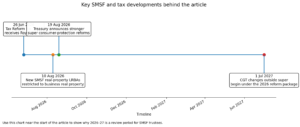
New limited recourse borrowing arrangements can now generally only be used by SMSFs to acquire business real property, rather than ordinary residential investment property.
Existing arrangements and certain transactions where a binding contract was exchanged before the commencement date remain protected under transitional rules.
For SMSF trustees who already own residential property through an LRBA, this does not necessarily mean they need to sell.
However, the change fundamentally alters the options available to funds considering their next property purchase.
The practical effect
Until recently, a trustee could potentially compare:
- Direct residential property using an LRBA
- Commercial property
- Listed property trusts
- Property ETFs
- Unlisted property funds
For new residential acquisitions, the borrowing option has now narrowed substantially.
Consequently, trustees who want property exposure may increasingly look toward listed or unlisted property investments rather than leveraged direct residential property.
That creates a new question.
Are those alternatives actually equivalent?
Not necessarily.
A direct property gives the SMSF direct ownership of an individual asset.
A property trust or ETF gives the SMSF units in an investment vehicle. That introduces different liquidity, diversification, management, valuation and tax characteristics.
The correct comparison is therefore no longer simply:
Property versus shares.
It may increasingly become:
Direct commercial property versus listed property trusts versus diversified property ETFs.
3. The Government Is Increasing Its Focus on SMSF Consumer Protection
The collapse of several investment schemes has also changed the regulatory environment surrounding superannuation.
The government announced further reforms in August designed to strengthen consumer protection across the super system.
The reforms include plans to give the ATO greater powers where it has well-founded concerns about money being transferred into an SMSF.
They also include stronger information sharing between regulators and basic trustee knowledge requirements.
This is significant because it shows how regulators increasingly view SMSF establishment and rollovers.
The focus is no longer only on whether the fund complies after it has been established.
Regulators also want to identify potentially harmful transactions before retirement money leaves the existing super system.
4. SMSF Trustees May Face Greater Expectations Around Financial Knowledge
For years, trustees have been responsible for understanding their obligations.
However, proposed reforms would formalise that expectation further through basic trustee knowledge requirements.
That makes sense when you consider what an SMSF trustee is responsible for.
Trustees may need to understand:
- Contributions
- Pensions
- Related-party transactions
- Investment restrictions
- Asset valuations
- Limited recourse borrowing
- Taxation
- Record keeping
- Estate planning
- Investment strategy requirements
An SMSF is not simply an investment account.
It is a regulated superannuation fund.
That distinction is becoming increasingly important.
5. How You Hold an Investment May Matter More Than Ever
There is another issue developing that could be particularly important for SMSFs that invest heavily in ETFs and managed funds.
Industry groups have raised concerns that proposed capital-gains tax changes could produce different tax outcomes depending on whether an SMSF owns an asset directly or receives the economic exposure through a managed investment trust.
That raises a broader investment question:
Should two economically similar investments produce different after-tax results simply because one is held directly and the other through a managed fund?
For trustees, this is worth watching closely.
ETFs have become popular partly because they offer:
- Diversification
- Low administration
- Daily liquidity
- Professional portfolio management
- Easy access to overseas markets
However, taxation happens partly inside the investment vehicle before the SMSF receives its distribution.
Therefore, trustees should look beyond the headline investment return.
The after-tax return inside the SMSF is what ultimately matters.
6. Global Diversification Is Becoming More Important
At the same time that Australia’s SMSF rules are changing, investment markets are becoming increasingly concentrated.
Australian SMSFs have traditionally held significant allocations to Australian shares, cash and property.
Those investments remain important.
However, major areas of global growth increasingly sit outside the Australian market.
These include:
- Artificial intelligence
- Global technology
- Semiconductor manufacturing
- Healthcare innovation
- Infrastructure
- Emerging markets
- Global consumer companies
That means trustees should consider whether their SMSF investment strategy has become unintentionally concentrated in Australia.
Home-market familiarity can feel safer.
But familiarity is not the same as diversification.
For example, an SMSF holding Australian banks, miners and residential property may own several different investments while still remaining heavily exposed to the Australian economy.
Global diversification can introduce different risks, including currency movements and geopolitical exposure.
Nevertheless, it can also reduce reliance on a single economy.
7. Higher Interest Rates Have Changed the Role of Cash
Cash has also become more important in SMSF strategy.
For many years, extremely low interest rates meant large cash holdings produced very little return.
That environment has changed.
Higher interest rates have increased the income available from:
- SMSF bank accounts
- Term deposits
- Cash ETFs
- Fixed-interest securities
- Short-duration bond funds
However, this does not mean trustees should automatically move heavily into cash.
Inflation still matters.
So does reinvestment risk.
The important point is that cash now performs two functions inside an SMSF:
- Liquidity and
- Income generation.
For funds paying pensions or preparing for tax liabilities, that combination can be particularly useful.
8. The Question Trustees Should Ask Is Changing
In the past, SMSF investment conversations often began with:
“What should my SMSF invest in?”
A better question for 2026 may be:
“Is the structure of my SMSF still appropriate for the way I want to invest?”
That requires looking at more than investment returns.
Trustees should consider:
- Tax
- Liquidity
- Investment structure
- Property borrowing
- Pension payments
- Contribution strategy
- Diversification
- Regulatory changes
- Estate planning
- Administrative complexity
An investment can perform well and still be poorly structured.
Likewise, an SMSF can remain compliant while its investment strategy gradually becomes outdated.
A 2026 SMSF Health Check
Before the next financial year progresses too far, SMSF trustees may want to review five areas.
1. Review your investment strategy
Does the strategy still reflect the fund’s actual investments?
If your asset allocation has changed substantially, the written strategy should not tell a different story from the portfolio.
2. Check liquidity
Can the SMSF meet:
- Tax payments
- Pension obligations
- Administration expenses
- Insurance costs
- Unexpected expenses
without being forced to sell an investment at the wrong time?
3. Review property arrangements
If the SMSF owns property through an LRBA, confirm that the loan structure and documentation remain appropriate.
If you were planning another residential purchase, review the new borrowing restrictions before taking any action.
4. Review managed funds and ETFs
Look beyond headline performance.
Consider:
- Distributions
- Capital gains
- Internal tax treatment
- AMIT cost-base adjustments
- Management fees
- Currency exposure
These can all affect the SMSF’s eventual after-tax return.
5. Check whether regulatory changes affect you
Large-balance members, property investors and trustees contemplating major rollovers should be particularly alert to the changing rules.
The Bigger Story
None of these developments means SMSFs have suddenly become unattractive.
In fact, the ability to control investments, tax planning and retirement strategy remains one of the major reasons Australians establish SMSFs.
However, control comes with responsibility.
The regulatory direction in 2026 is clear.
Governments and regulators want SMSF trustees to demonstrate that they understand their obligations, understand the investments they are making and have appropriate structures around their retirement savings.
For existing trustees, that makes this an excellent time to review not only what the SMSF owns, but also why it owns it and how those investments are structured.
Sometimes the most important SMSF decision is not choosing the next investment.
It is making sure the fund you already have is still structured for the next decade.
This article provides general information only and does not take account of your objectives, financial situation or needs. It is not personal financial, taxation or legal advice. SMSF trustees should obtain appropriate professional advice before making investment, contribution, pension or restructuring decisions.