

SMSF Franking Credit Strategies : How to Maximise Your Returns Contents Understanding Franking Credits Benefits of Franking Credits for SMSFs Top Fully Franked Dividend Stocks Franking Credit Calculation Examples Compliance Essentials Balancing Yield and Growth Risks and Legislative Considerations FAQs Conclusion: Maximising SMSF Returns Action Steps for SMSF Trustees SMSF Franking Credit Strategies : How […]
SMSF Franking Credit Strategies : How to Maximise Your Returns
Contents
SMSF Franking Credit Strategies : How to Maximise Your Returns
SMSF Franking credit strategies remain one of the most effective tools available to SMSF trustees seeking to boost their after-tax income and build wealth efficiently. Leveraging these tax credits can significantly enhance SMSF returns, particularly for those nearing or already in retirement. MySMSFs guide highlights practical strategies, real-world examples and visual aids to ensure SMSF trustees can confidently incorporate franking credits into their investment approach.
Understanding Franking Credits
SMSF Franking credit strategies (or imputation credits) are tax credits attached to dividends paid by Australian companies. They reflect tax already paid by the company on its profits. For SMSFs, especially those in pension phase, these credits can offset tax liabilities or result in tax refunds, substantially increasing income and returns.
Example: How Franking Credits Work
| Company Profit | Company Tax Paid (30%) | Dividend Paid | Franking Credit | Gross Dividend |
|---|---|---|---|---|
| $1,000 | $300 | $700 | $300 | $1,000 |
-
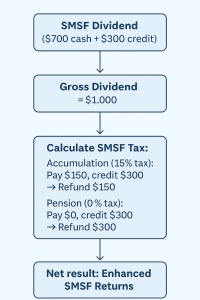
Your SMSF receives $700 cash and a $300 franking credit.
-
Gross dividend for tax purposes is $1,000.
Benefits of Franking Credits for SMSFs
1. Tax Efficiency
-
Accumulation phase: SMSFs taxed at 15%; credits offset tax.
-
Pension phase: SMSFs taxed at 0%; excess credits refunded as cash.
2. Increased Income
Franking credits increase total income received, boosting compounding returns over time.
3. Strategic Investment Choices
Investing in fully franked dividend paying stocks can provide a reliable income stream and reduce the fund’s overall tax burden.
Top Fully Franked Dividend Stocks
SMSF trustees often focus on blue-chip Australian stocks offering fully franked dividends. Three prominent examples are:
| Company | ASX Code | Industry | Dividend Yield | Franking |
|---|---|---|---|---|
| BHP Group Ltd | BHP | Mining | ~5.00% | 100% |
| Westpac Banking Corp | WBC | Financials | ~5.49% | 100% |
| Woodside Energy Group Ltd | WDS | Oil & Gas | ~7.92% | 100% |
Source: ASX market data as of mid-2024
Franking Credit Calculation Examples
Example 1: SMSF in Accumulation Phase (15% Tax Rate)
| Item | Calculation | Amount |
|---|---|---|
| Grossed-up Dividend | $700 + $300 | $1,000 |
| SMSF Tax (15%) | $1,000 × 15% | $150 |
| Franking Credit Received | $300 | |
| Net Result | $150 tax – $300 credit | $150 Refund |
Example 2: SMSF in Pension Phase (0% Tax Rate)
| Item | Calculation | Amount |
|---|---|---|
| Grossed-up Dividend | $700 + $300 | $1,000 |
| SMSF Tax (0%) | $1,000 × 0% | $0 |
| Franking Credit Received | $300 | |
| Net Result | $0 tax – $300 credit | $300 Refund |
📊 SMSF Returns With and Without Franking Credits
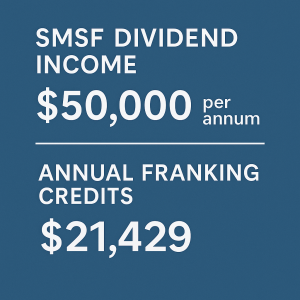
| Scenario | Cash Income | Franking Credit Refund | Total Income |
|---|---|---|---|
| SMSF (Accumulation 15%) | $50,000 | $13,929 | $63,929 |
| SMSF (Pension 0%) | $50,000 | $21,429 | $71,429 |
Franking credits can boost SMSF income by up to 43%.
Compliance Essentials
Holding Period Rule
To claim franking credits, SMSFs must hold shares at risk for 45 days (excluding purchase and sale days).
| Transaction | Minimum Holding Period |
|---|---|
| Dividend from Shares | 45 Days “At Risk” |
Non-compliance may result in losing credits entirely.
Balancing Yield and Growth
While targeting fully franked dividends, SMSFs must still maintain diversification:
| Recommended Asset Allocation | Target (%) |
|---|---|
| Australian Shares (fully franked) | 40% |
| Global Shares (growth focus) | 20% |
| Fixed Interest | 20% |
| Property | 10% |
| Cash | 10% |
📈 How Franking Credits Boost SMSF Returns
Risks and Legislative Considerations
SMSF franking credit strategies, may be influenced by Regulatory changes. SMSF trustees must stay updated with policy shifts, particularly surrounding tax reforms and superannuation.
Conclusion: Maximising SMSF Returns
SMSF Franking credit Strategies, remain highly beneficial for SMSFs seeking reliable, tax effective income. By:
✅ Targeting companies paying fully franked dividends Australia
✅ Ensuring compliance with holding period rules
✅ Diversifying beyond dividends
Trustees can significantly enhance the tax efficiency and income generation of their SMSFs.
Action Steps for SMSF Trustees
-
Review your portfolio for fully franked dividend-paying stocks.
-
Regularly rebalance your portfolio to maintain diversification.
-
Confirm compliance with holding period requirements.
-
Regularly consult with your SMSF adviser to adapt to any legislative changes.
FAQs
1. Are franking credits refundable for SMSFs in pension phase?
Yes, SMSFs in pension phase (0% tax) are entitled to a full refund of franking credits, enhancing their total income.
2. What happens if my SMSF doesn’t meet the holding period rule?
If the SMSF doesn’t hold shares for the required 45 days “at risk,” it cannot claim franking credits associated with those dividends.
3. Can franking credits offset SMSF capital gains tax?
Yes, franking credits can offset other SMSF taxes, including capital gains tax, reducing overall tax liability.
Additional Resources
Disclaimer: This article provides general information only and is not financial advice. SMSF trustees should consult professional advisers tailored to their specific circumstances.