
The 5 Best High-Income ETFs for Australian SMSFs (Including Global Income and a Core–Satellite Structure) Many SMSFs prioritise reliable income to fund pensions and grow member balances tax-effectively. High-dividend exchange-traded funds (ETFs) can help by bundling a diversified portfolio of income-paying shares into a single ASX-listed investment, with regular distributions and, for Australian shares, franking […]
The 5 Best High-Income ETFs for Australian SMSFs
(Including Global Income and a Core–Satellite Structure)
Many SMSFs prioritise reliable income to fund pensions and grow member balances tax-effectively. High-dividend exchange-traded funds (ETFs) can help by bundling a diversified portfolio of income-paying shares into a single ASX-listed investment, with regular distributions and, for Australian shares, franking credits.
This guide covers five high-income ETFs that Australian SMSFs commonly consider:
-
SYI – SPDR MSCI Australia Select High Dividend Yield ETF
-
VHY – Vanguard Australian Shares High Yield ETF
-
ZYAU – Global X S&P/ASX 200 High Dividend ETF
-
WDIV – SPDR S&P Global Dividend Fund (Global)
-
INCM – BetaShares Global Income Leaders ETF (Global ex-AU)
We also explain how to use these within a core–satellite portfolio to improve diversification and keep your SMSF investment strategy and audit documentation clear.
Important: All yields shown are trailing and indicative only, based on recent public data. They will change over time and are not guaranteed.
Contents
-
ETF profiles – what each fund does
-
3.1 SYI – SPDR MSCI Australia Select High Dividend Yield ETF
-
3.2 VHY – Vanguard Australian Shares High Yield ETF
-
3.3 ZYAU – Global X S&P/ASX 200 High Dividend ETF
-
3.4 WDIV – SPDR S&P Global Dividend Fund
-
3.5 INCM – BetaShares Global Income Leaders ETF
-
Why high-income ETFs appeal to SMSFs
High-income ETFs work well in SMSFs because they:
-
Provide diversified exposure to many dividend-paying companies via a single ASX trade;
-
Pay regular distributions (typically quarterly), which can be used for pension payments or reinvested;
-
Pass through franked dividends for Australian share ETFs, which can be very tax-effective in accumulation and pension phase;
-
Issue annual tax statements summarising income, franking and foreign tax credits, making SMSF accounting and audit more efficient.
Adding global dividend ETFs (WDIV, INCM) also helps reduce home bias, introducing income from sectors and regions not available on the ASX.
Top 5 high-income ETFs – summary table
Indicative yields below are based on recent trailing dividend yield data from ETF issuers and independent research (mid–late 2025). Figures are rounded and for illustration only.
| ETF | Code | Region | Main focus | Management cost (p.a.) | Indicative trailing yield* | Distribution | Provider |
|---|---|---|---|---|---|---|---|
| SPDR MSCI Australia Select High Dividend Yield ETF | SYI | Australia | High-dividend Aussie shares with quality screen (MSCI Australia Select High Dividend Yield Index) | ~0.20% (check PDS) | ~12–13% recent trailing yield (very high) – indicative only | Quarterly | State Street (SPDR) |
| Vanguard Australian Shares High Yield ETF | VHY | Australia | Broad high-yield Aussie shares (FTSE Australia High Dividend Yield Index) | 0.25% p.a. | ~8–9% recent trailing yield (Stockspot example: ~8.6%) | Quarterly | Vanguard |
| Global X S&P/ASX 200 High Dividend ETF | ZYAU | Australia | 50 high-dividend stocks from the S&P/ASX 200 High Dividend Index | 0.24% p.a. | ~4–5% 12-month yield (e.g. ~4.3–4.5%) | Quarterly | Global X |
| SPDR S&P Global Dividend Fund | WDIV | Global | Global “Dividend Aristocrats” – companies with ≥10 years of stable/increasing dividends | ~0.35–0.40% p.a. (check PDS) | ~4–6% global dividend yield (e.g. around 4.3% in recent data) | At least semi-annual | State Street (SPDR) |
| BetaShares Global Income Leaders ETF | INCM | Global (ex-AU) | 100 high-yielding global “income leaders” with 10+ years of maintained/increased dividends | ~0.45–0.50% p.a. (check PDS) | ~5.8–6% dividend yield (e.g. ~5.9%) | Quarterly | BetaShares |
*Yields are trailing and indicative only, before any impact of franking credits or foreign tax offsets. They change over time and are not guaranteed.
ETF profiles – what each fund does
SYI – SPDR MSCI Australia Select High Dividend Yield ETF (Satellite – Income Booster)
-
Tracks the MSCI Australia Select High Dividend Yield Index, which targets Australian companies with higher dividend income and quality characteristics and the potential for franked dividends.
-
Invests in a diversified portfolio of ASX-listed shares with a focus on persistent and sustainable dividends.
Why SMSFs use it
-
Very high trailing yield (recently around 12–13% on some measures).
-
Suitable as a satellite allocation to lift income on top of more diversified core holdings.
Key risks
-
Higher concentration in sectors such as financials and other high-yield names – income and capital values can be more volatile.
VHY – Vanguard Australian Shares High Yield ETF (Core)
-
Seeks to track the FTSE Australia High Dividend Yield Index, providing broad exposure to around 60+ of Australia’s top dividend-paying companies for a 0.25% p.a. fee.
-
Widely regarded as a core Australian high-dividend ETF, with strong diversification across banks, miners, industrials and other sectors.
Why SMSFs use it
-
Natural core high-income holding for the Australian share component of an SMSF.
-
Regular franked distributions can be powerful in both accumulation and pension phase.
Key risks
-
Still 100% Australian equity exposure, so it does not resolve home bias by itself.
ZYAU – Global X S&P/ASX 200 High Dividend ETF (Core)
-
Invests in 50 high-dividend stocks from the S&P/ASX 200, using a rules-based screen for high forecast dividend yield.
-
Provides focused exposure to top dividend payers in the ASX 200.
Why SMSFs use it
-
Works well alongside VHY as part of a core high-income Australian sleeve.
-
Quarterly distributions with high franking levels in recent years.
Key risks
-
Sector tilts can be pronounced – often heavy in financials and resources, similar to other Aussie dividend ETFs.
WDIV – SPDR S&P Global Dividend Fund (Core Global)
-
Seeks to track the S&P Global Dividend Aristocrats Index, which includes companies from around the world that have maintained or increased dividends for at least 10 consecutive years.
-
Offers diversified exposure across US, Europe and other developed markets, with a global income focus.
Why SMSFs use it
-
Provides global diversification to complement Australian income holdings.
-
Focus on long-term dividend sustainability rather than one-off high yields.
Key risks
-
No franking credits – distributions are mainly foreign dividends, with foreign tax offsets available through the SMSF tax return.
-
Currency risk: AUD movements will affect capital and income in Australian dollar terms.
INCM – BetaShares Global Income Leaders ETF (Satellite Global)
-
Aims to track an index of 100 high-yielding global companies (ex-Australia) that have maintained or increased dividends every year for at least 10 years.
-
Designed specifically as a global income product, with quarterly distributions.
Why SMSFs use it
-
Acts as a global income booster satellite around core Australian and global holdings.
-
Adds exposure to defensive global sectors such as utilities, REITs and consumer staples that often pay higher dividends.
Key risks
-
No franking credits; all income is unfranked foreign income.
-
Still an equity product – distributions and unit prices can move with global markets.
Asset diversification and the core–satellite process
Why diversification matters for SMSFs
Most SMSFs already have meaningful exposure to:
-
Australian shares (often bank-heavy); and
-
Direct property (sometimes via LRBAs).
Simply adding more Australia-only high-yield ETFs can increase concentration risk, even if income rises.
Introducing global dividend ETFs like WDIV and INCM:
-
Adds sectors not well-represented on the ASX;
-
Reduces reliance on the Australian economy and government policy alone; and
-
Provides a broader spread of income sources.
This fits directly with the ATO’s expectations around a diversified SMSF investment strategy, especially where SMSFs are heavily exposed to one asset class or sector.
Using core–satellite to structure your ETF portfolio
A core–satellite framework is a simple way to organise your ETF holdings:
-
Core holdings – broad, diversified exposures that form the bulk of the portfolio and are intended to be held long-term.
-
Satellite holdings – smaller, more targeted exposures to achieve specific goals such as higher income or ESG tilts.
Example classification for these 5 ETFs:
-
Core:
-
VHY – core Australian high-yield
-
ZYAU – complementary Australian high-dividend slice
-
WDIV – global “dividend aristocrats” core
-
-
Satellite:
-
SYI – Australian high-yield “booster”
-
INCM – global income “booster”
-
Example (illustrative only) allocation
For the equity income sleeve of an SMSF (not the whole fund):
-
Core (70%)
-
30% VHY
-
20% ZYAU
-
20% WDIV
-
-
Satellite (30%)
-
20% SYI
-
10% INCM
-
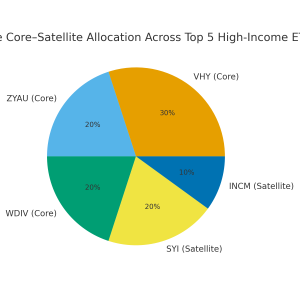
This is not a recommendation, just an example of how a trustee might:
-
Use Australian high-yield ETFs as the income core;
-
Add WDIV to diversify globally; and
-
Layer SYI and INCM as targeted high-income satellites.
In your SMSF investment strategy and trustee minutes, you would:
-
Note that the core holdings provide diversified, long-term exposure;
-
Describe satellites like SYI and INCM as specific income tilts; and
-
Confirm that overall risk, diversification, liquidity and cash-flow needs have been considered.
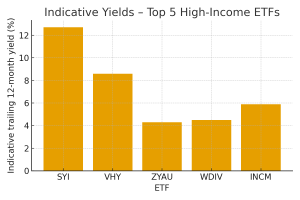
Indicative yields – Top 5 high-income ETFs
-
SYI shows the highest trailing yield, but with greater sector concentration risk.
-
VHY and WDIV provide strong income with more diversified cores.
-
ZYAU and INCM sit in the mid-yield range and can be blended to balance risk and income.
Example core–satellite allocation
This illustrative pie chart shows:
-
Core slices – VHY, ZYAU, WDIV
-
Satellite slices – SYI, INCM
Trustees can adjust weights according to their risk profile, age and retirement timeframe, but the core–satellite structure itself helps keep decisions organised.
What SMSF auditors look for
When your fund invests in high-income ETFs, auditors typically review:
-
Investment strategy alignment
-
Does your written strategy allow for listed securities and ETFs?
-
Are income needs, diversification and liquidity clearly addressed?
-
-
Evidence and records
-
Broker contract notes for ETF trades;
-
Distribution and tax statements from ETF issuers;
-
Bank statements showing distributions received.
-
-
Liquidity and pension payments
-
Especially in pension phase, is there enough liquid income/cash to meet minimum pension requirements and expenses?
-
-
Risk and concentration
-
Even via ETFs, too much in one sector or country can still be an issue. Adding WDIV and INCM typically improves that picture.
-
FAQs – High-yield ETFs and your SMSF
1. Are these ETFs suitable for pension-phase SMSFs?
They can be, because regular distributions and franking credits (for Aussie funds) are useful for funding pensions. In pension phase, where the fund tax rate is 0% within the transfer balance cap, excess franking credits may be refunded, which is attractive. Suitability always depends on your broader asset mix and risk tolerance.
2. Will global income ETFs give me franking credits?
No. Global ETFs like WDIV and INCM pay unfranked foreign dividends. You may receive foreign income tax offsets instead. These are still valuable but work differently to franking credits.
3. Why not just buy the big 4 banks for dividends?
Direct bank shares can provide high yield, but:
-
Concentrate risk into very few companies; and
-
Make your portfolio heavily tied to one sector.
High-income ETFs spread risk across many companies and sectors and follow transparent index rules, which can be easier to justify in your SMSF investment strategy and audit.
4. How often do these ETFs pay income?
Most high-income ETFs on the ASX (SYI, VHY, ZYAU, INCM) pay quarterly distributions. WDIV distributions are at least semi-annual and may be more frequent depending on the share class. Always check the current PDS and fact sheet.
5. Can my SMSF use DRP (Dividend Reinvestment Plan) with these ETFs?
Where a DRP is offered, the fund can elect to reinvest distributions into more ETF units instead of taking cash. Trustees must ensure this is consistent with:
-
Liquidity needs (for pensions and expenses); and
-
Their investment strategy, especially if they rely on cash flow to meet minimum pension payments.
General advice disclaimer
This article is prepared by My SMSF as general information only and does not take into account your personal objectives, financial situation or needs. It is not financial product advice, taxation advice or legal advice.
-
Past performance and past yields are not reliable indicators of future returns.
-
Yields quoted are approximate trailing figures based on recent public data and may change at any time.
-
Before acting on any information in this article, you should consider whether it is appropriate in light of your circumstances and seek advice from a licensed financial adviser
-
Always read the Product Disclosure Statement (PDS) and current fact sheets for each ETF before investing.