

The New Retirement Reality: Three Trends Every SMSF Trustee Needs to Know Insights from MLC’s Real Retirement Report 2026 The retirement landscape in Australia is shifting faster than many realise. MLC’s latest Real Retirement Report, based on a nationally representative survey of 2,500 Australians conducted by McCrindle Research, reveals a nation that is simultaneously more […]
The New Retirement Reality: Three Trends Every SMSF Trustee Needs to Know
Insights from MLC’s Real Retirement Report 2026
The retirement landscape in Australia is shifting faster than many realise. MLC’s latest Real Retirement Report, based on a nationally representative survey of 2,500 Australians conducted by McCrindle Research, reveals a nation that is simultaneously more anxious and more proactive about retirement than ever before. For SMSF trustees who by definition take direct control of their retirement destiny understanding these shifts is not optional. It is essential. Here are the three defining themes from the 2026 retirement research and what they mean for your SMSF.
Theme 1: The Confidence Paradox — Younger Australians Are Leading the Charge
A striking finding from the MLC report is that Generation Z has overtaken Gen Y as the most financially confident generation in Australia. Despite reporting the highest levels of financial frustration (37%), Gen Z Australians are engaging with retirement planning earlier and more aggressively than any previous generation.
Key stats:
- 44% of Gen Z believe they are on track for a comfortable retirement
- 37% believe they can meet their financial needs in retirement
- 45% rank “having enough to retire comfortably” as a top life goal, equal with home ownership
- They expect to retire at 63—the earliest of any generation
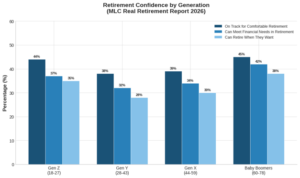
This represents a fundamental behavioural shift. Younger Australians are talking openly about money, setting goals, learning about superannuation and taking meaningful action far earlier than their parents did. As MLC’s chief customer officer Renee Howie noted, “They’re talking openly and honestly about money, setting goals, learning about superannuation and thinking about retirement well before previous generations did.”
What this means for SMSFs: If you established your SMSF later in life, consider whether the next generation in your family is being brought into the conversation early enough. SMSFs offer unparalleled control, but that control requires financial literacy. The data suggests that those who start engaging with retirement mechanics in their 20s and 30s build more robust long-term outcomes. For trustees with adult children, this is a timely reminder to discuss succession planning and member education.
Theme 2: The Gender Retirement Gap Remains a National Challenge
Despite decades of progress, the MLC report confirms that women continue to face a significant retirement confidence and preparedness gap. Only 25% of women expect to be able to retire when they want, compared to 37% of men. Similarly, just 32% of women believe they are on track for a comfortable retirement, versus 50% of men.
This aligns with global research showing that women face a persistent retirement savings gap driven by lower lifetime earnings, career interruptions for caregiving, longer life expectancies and higher rates of part-time work.
What this means for SMSFs: SMSF structures can be powerful tools for addressing the gender retirement gap—but only if used deliberately. For couples running an SMSF, consider:
- Ensuring both members are actively involved in investment decisions
- Reviewing whether contribution strategies (including spouse contributions and catch-up concessional contributions) are being optimised for the lower-balance member
- Evaluating whether the fund’s investment strategy adequately accounts for the longer retirement horizon that women typically face
For single women with SMSFs, the message is clear: the structural headwinds are real, but the control an SMSF provides over investment strategy, fee management and retirement timing can be a meaningful counterbalance—provided the strategy is actively managed.
Theme 3: Cost-of-Living Pressures Are Reshaping Retirement Timelines
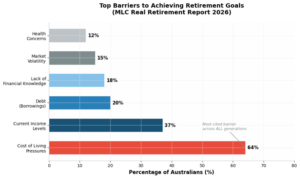
The most commonly cited barrier to achieving financial goals across all generations is cost-of-living pressures, cited by 64% of Australians. This is followed by current income (37%) and debt (20%).
The consequence? Australians feel less in control of when and how they retire. Nationally, only 31% expect to be able to retire when they want to and just 41% believe they are on track for a comfortable retirement.
This pressure is not just psychological. Research from the 2026 EBRI Retirement Confidence Survey shows that rising housing costs, healthcare expenses and debt are increasingly interfering with both the ability to save for retirement and the capacity to live comfortably once retired.
What this means for SMSFs: SMSF trustees have tools available that many APRA fund members do not:
- Direct property investment (including commercial property) can provide both inflation hedging and income streams
- Diversification into alternative assets—including precious metals and, where appropriate, cryptocurrency—can offer non-correlated returns
- Flexible pension drawdown strategies allow trustees to adjust income levels in response to market conditions and personal needs, rather than being locked into rigid product structures
However, with the transfer balance cap having indexed to $2 million on 1 July 2026, trustees should also review whether their pension phase structuring is optimised for the new limits.
The Bottom Line for SMSF Trustees
The 2026 retirement research paints a picture of a nation under financial pressure but increasingly unwilling to remain passive. For SMSF trustees, this is both a warning and an opportunity.
The warning: cost-of-living pressures, longevity risk and structural gender gaps are real forces that will test even well-constructed retirement strategies.
The opportunity: SMSFs remain the most flexible retirement vehicle available in Australia. Trustees who actively engage with their fund’s investment strategy, contribution planning and pension structuring—rather than setting and forgetting—are best positioned to navigate the new retirement reality.
As the data shows, retirement confidence is not a function of age. It is a function of engagement. The earlier and more deliberately you engage, the better your outcome.
This article is for informational purposes only and does not constitute financial advice. SMSF trustees should consult with their licensed financial adviser and tax professional before making decisions about their retirement strategy.
Ready to review your SMSF strategy? Contact our team to discuss how these trends may impact your fund’s investment and retirement planning approach.
Sources: MLC Real Retirement Report (July 2026), McCrindle Research; KPMG Super Insights 2026; EBRI 2026 Retirement Confidence Survey. This article is general information only. Please conduct your own research on investment suitability or seek financial advice from a licensed financial planner.