

SMSF Share & ETF Investing and Trading Course
Secure your spot for $22 (once-off). After payment, we’ll email your login and unlock all lessons and the certificate.
You’re viewing a locked lesson preview. Purchase unlocks all 8 lessons, quizzes and the certificate.
Knowing the building blocks is not enough — you need an architecture. This lesson introduces the two strategy pillars used throughout this course: diversification (spreading risk so no single failure can sink your fund) and the core-satellite model (a stable, low-cost core surrounded by smaller, higher-conviction satellite positions). Both strategies map directly onto the diversification and risk considerations the law requires in your SMSF investment strategy.
- Explain how diversification reduces portfolio risk and its limits
- Diversify across asset classes, sectors, geographies and time
- Describe the core-satellite model and design an allocation for your fund
- Link portfolio construction choices to your SMSF investment strategy document
Estimated time: 60 minutes
2.1 Diversification and Risk Management
The Only Free Lunch in Investing
Nobel laureate Harry Markowitz called diversification “the only free lunch in investing”. The idea: different investments rarely fall at the same time. When one holding zigs down, another zags up, so the portfolio’s overall ride is smoother than any single holding’s. Crucially, you give up little or no expected return to get this smoother ride — hence, free lunch.
Diversification benefits:
- Reduces overall portfolio risk without proportionally reducing expected return
- Provides greater portfolio stability and smaller peak-to-trough falls
- Protects the fund against single-company, single-sector and single-country shocks
- Helps trustees sleep at night — and stick to the plan through downturns
The Four Dimensions of Diversification
| Dimension | What It Means | Practical Examples for an SMSF |
|---|---|---|
| Asset classes | Spread across investments that behave differently | Australian shares, international shares, bonds, listed property (REITs), gold, cash |
| Sectors | Avoid concentration in one industry | Balance banks/miners (ASX-heavy) with healthcare, technology, consumer, industrials |
| Geography | Australia is under 2% of world markets | Add US, developed international and emerging-market exposure via ETFs |
| Time | Don’t invest everything on one day | Dollar-cost average entries (Lesson 1); stagger exits (Lesson 6) |
Diversification impact on portfolio risk
| Portfolio | Number of Holdings | Risk Level | What One Bad Holding Can Do |
|---|---|---|---|
| A | 1 | High | A collapse wipes out most of the portfolio |
| B | 5 | Medium–High | A collapse costs roughly 20% |
| C | 10 | Medium | A collapse costs roughly 10% |
| D | 20–30 | Lower | Single-stock risk largely diluted away |
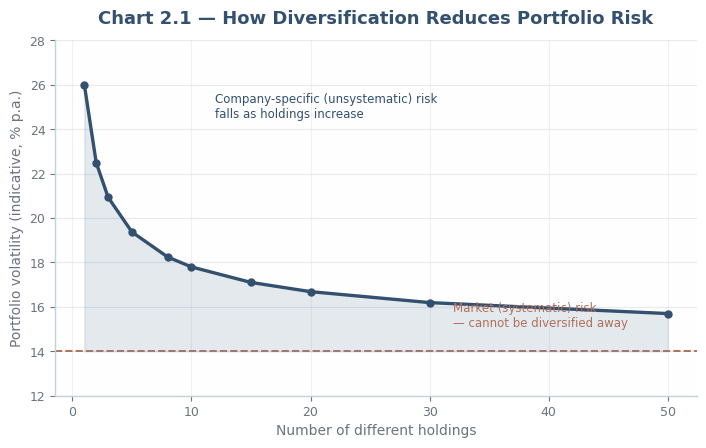
The chart below shows the mathematical reality: adding holdings removes company-specific (unsystematic) risk quickly at first, then with diminishing returns — most of the benefit arrives by 20–30 holdings. What remains is market (systematic) risk, which no amount of diversification within shares can remove; only other asset classes (bonds, cash, gold) or time can address that.
Diversification and Your SMSF Investment Strategy
The superannuation regulations require trustees to formulate an investment strategy that has regard to diversification (investing in various asset classes), the risks of inadequate diversification, liquidity and the fund’s ability to discharge its liabilities. A concentrated portfolio (for example, one property or one stock) is not automatically non-compliant, but the trustee minutes and strategy document must explain why the concentration is appropriate for the members’ circumstances. The core-satellite model below is one of the cleanest ways to demonstrate compliance while still pursuing strong returns.
2.2 The Core and Satellite Portfolio Model
How the Model Works
The core-satellite model divides the portfolio into two parts:
The Core (typically 60–80%):
- Broad-market index funds or low-cost ETFs — e.g. an ASX 200 or All-Ords ETF, a global shares ETF
- Designed for stability, low cost and steady, market-like returns
- Requires minimal maintenance; the “set and (mostly) forget” engine of the portfolio
The Satellites (typically 20–40%):
- Individual shares, sector ETFs, thematic ETFs or other higher-conviction ideas
- Aimed at enhancing returns or adding targeted income (e.g. high-yield franked shares)
- Sized so that even a total satellite failure cannot cripple retirement plans
Core vs Satellite — Side by Side
| Characteristic | Core (60–80%) | Satellites (20–40%) |
|---|---|---|
| Holdings | Broad index ETFs | Individual shares, sector/thematic ETFs |
| Risk level | Low–moderate | Moderate–high |
| Cost | Very low MER | Brokerage per trade; some higher MERs |
| Effort required | Review once or twice a year | Active monitoring and research |
| Role | Reliable market-matching growth | Return enhancement, income, interest |
| Failure tolerance | Designed never to fail outright | Any single satellite may fail; portfolio survives |
Watch: Core vs Satellite in 60 seconds
The two-sleeve portfolio design, why the split works and the one rule that keeps it holding together over time — condensed into a 60-second stickman animation:
Example core-satellite portfolio for a balanced SMSF
| Component | Allocation | Example Holding Type | Purpose |
|---|---|---|---|
| Core — Australian shares | 45% | Broad ASX 200/300 index ETF | Franked income + growth |
| Core — Global shares | 25% | MSCI World or global all-cap ETF | Diversification beyond Australia |
| Satellite — Blue-chip shares | 12% | 3–5 quality ASX companies | Conviction + dividend income |
| Satellite — Technology/sector ETF | 8% | Global tech or healthcare ETF | Growth tilt |
| Satellite — Small companies | 6% | Australian small-caps ETF | Higher growth potential |
| Satellite — Thematic | 4% | e.g. clean energy, infrastructure | Personal interest/conviction |
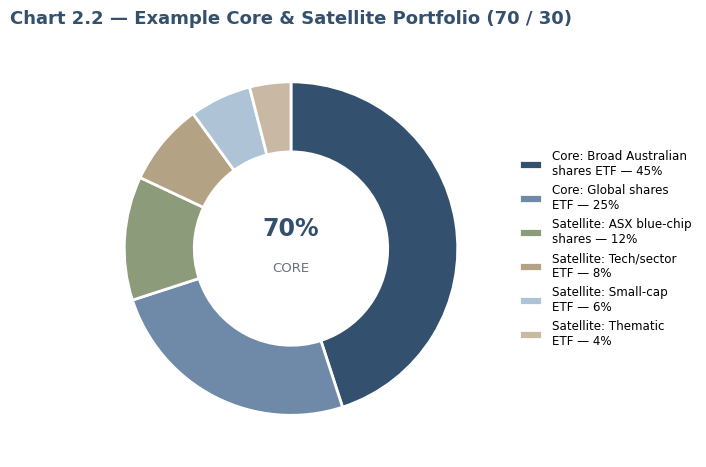
A trustee with a $400,000 portfolio and a 70/30 structure holds $280,000 in core ETFs and up to $120,000 across satellites. If the largest single satellite is capped at $20,000 (5% of the portfolio), even that company going to zero — the worst case — costs the fund 5%, recoverable in an average market year. That is what “survivable risk” looks like in practice and it is exactly the kind of reasoning an auditor likes to see documented in trustee minutes.
Lesson 2 Summary — Key Takeaways
- Diversification is the only free lunch in investing: it cuts company-specific risk without sacrificing expected return
- Diversify across four dimensions: asset class, sector, geography and time
- Most single-stock risk disappears by 20–30 holdings; remaining market risk is managed with other asset classes and time horizon
- The core-satellite model pairs a low-cost, stable core (60–80%) with higher-conviction satellites (20–40%), sized so any single failure is survivable
- Both strategies directly support the diversification and risk requirements of your written SMSF investment strategy — document your reasoning in trustee minutes
Read The Importance of Diversification on Vanguard’s site. Then sketch a core-satellite allocation for your own fund: choose your core/satellite split, name the asset classes in your core and list no more than five satellite ideas with a maximum dollar size for each.
One single-choice question on the benefits and limits of diversification, plus a short text response describing your core-satellite plan (asset types and allocation percentages).
Finish Course Early?
You have not completed all required lessons and assessments.