

SMSF Share & ETF Investing and Trading Course
Secure your spot for $22 (once-off). After payment, we’ll email your login and unlock all lessons and the certificate.
You’re viewing a locked lesson preview. Purchase unlocks all 8 lessons, quizzes and the certificate.
Every professional investor has an exit plan before they enter a trade — and SMSF trustees, managing retirement money that must last decades, need one more than most. This lesson covers the tools that automate downside protection (stop-loss and take-profit orders) and the judgement that guides them (a written exit strategy). The aim is not to avoid losses — losses are part of investing — but to keep every loss small, planned and survivable.
- Set up stop-loss and take-profit orders and calculate appropriate levels
- Define a personal exit strategy covering profits, losses and changing conditions
- Apply position sizing and the 2% risk rule to individual trades
- Document exit decisions for fund governance
Estimated time: 60 minutes
6.1 Setting Up Stop-Loss and Take-Profit Orders
Watch: The 5 Risk Rules for Share Investing
Diversification, position sizing, stop losses, support bands and the one rule that makes wealth compound risk-free — taking your initial capital off the table on a double. 60 second stickman animation:
Stop-Loss Orders — Your Pre-Committed Safety Net
A stop-loss order instructs the broker to sell a security automatically if its price falls to a level you nominate. Its power is psychological as much as financial: the decision to cut a loss is made calmly, in advance, rather than in the panic of a falling market.
Setting the level — common approaches:
| Approach | Example | Suits |
|---|---|---|
| Fixed percentage | Sell if price falls 8–10% below purchase | Simple, consistent discipline |
| Volatility-based | 2× the average daily price range below entry | Volatile stocks need wider stops |
| Technical level | Just below a chart support level or key moving average | Trustees using technical analysis (Lesson 3) |
Cautions: in a sharp gap-down (e.g. a bad announcement overnight), a stop-loss executes at the next available price, which can be below your stop level. Stops also work poorly in very illiquid stocks. They are a damage-limiter, not a guarantee.
Take-Profit Orders — Banking Gains Without Watching the Screen
A take-profit order (a limit sell above the current price) automatically locks in gains when a target is reached. It answers the hardest question in investing — “when do I sell a winner?” — before emotion gets a vote. Many trustees scale out: sell a third at +15%, a third at +25% and let the remainder run with a trailing stop.
Stop-Loss vs Take-Profit
| Order Type | Purpose | Function | Placement |
|---|---|---|---|
| Stop-Loss | Limit losses | Sells when price falls to a set level | Below purchase price (for a buy) |
| Take-Profit | Secure profits | Sells when price reaches a target level | Above purchase price (for a buy) |
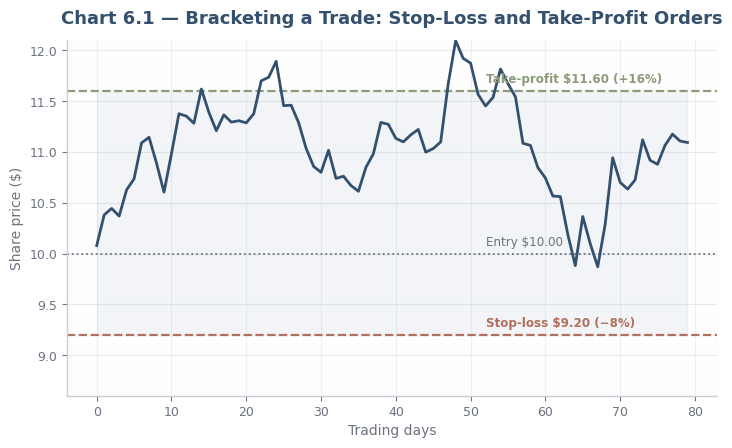
Your fund buys 1,000 shares at $10.00 ($10,000 position). Following your exit rules you set a stop-loss at $9.20 (−8%) and a take-profit at $11.60 (+16%).
| Outcome | Price | Result | Portfolio Impact |
|---|---|---|---|
| Take-profit triggers | $11.60 | +$1,600 gain | Risk/reward 2:1 achieved |
| Stop-loss triggers | $9.20 | −$800 loss | Loss capped and pre-planned |
The planned risk/reward ratio is 2:1 — you stand to make twice what you risk. With a 2:1 ratio, a strategy can be profitable even winning only 4 trades out of 10.
6.2 Implementing Exit Strategies
The Three Pillars of a Written Exit Strategy
1. Profit-taking rules. Define in advance what “success” looks like: a price target, a valuation level (e.g. “sell if the P/E exceeds 25”), or a rebalancing trigger (a position growing beyond its satellite cap). Partial selling — banking a portion while letting the rest run — balances discipline with upside.
2. Loss-mitigation rules. Decide the maximum acceptable loss per position before buying. A widely used guideline is the 2% rule: never risk more than 2% of total portfolio value on a single position’s stop-loss distance. On a $300,000 portfolio that caps planned risk at $6,000 — which, with an 8% stop, means a maximum position size of $75,000. In practice, satellite positions should be far smaller (recall the $20,000 cap in Lesson 2).
3. Market-condition adjustments. Exit rules should flex with conditions, not with moods. In a broad bull market, trailing stops can be loosened to give winners room; when volatility spikes or your fund approaches pension phase, tighten stops, raise cash and prioritise liquidity. Significant, sustained changes belong in the investment strategy review (Lesson 5), minuted by trustees.
Exit strategy considerations
| Consideration | Description | Trustee Action |
|---|---|---|
| Profit-taking | Criteria for banking gains | Set targets at entry; scale out in thirds |
| Loss mitigation | Rules for cutting losses | Stop-loss at entry; apply the 2% rule |
| Market conditions | Adjusting to changing environments | Review quarterly; minute material changes |
| Liquidity needs | Pension payments and fund expenses | Keep a cash buffer; plan sales ahead of payment dates |
| Tax position | 12-month CGT discount timing | Where practical, hold winners past 12 months for the 10% effective rate |
Studies of investor behaviour repeatedly show that the biggest destroyer of returns is not fees or bad stocks — it is panic selling in downturns and chasing spikes. A written exit strategy, agreed by all trustees in calm conditions, is the single best defence. When markets fall sharply, the correct response is to consult the plan, not the headlines.
Lesson 6 Summary — Key Takeaways
- Stop-losses cap downside and remove emotion from loss decisions; set them at entry using a percentage, volatility or technical level
- Take-profits bank gains automatically; scaling out balances discipline with upside
- Bracket every trade with a planned risk/reward ratio (aim for at least 2:1)
- Apply the 2% rule so no single position can materially damage the fund
- A written exit strategy — profit rules, loss rules, condition adjustments — minuted by trustees, is both good investing and good governance
Read Exit Strategies for Traders on Investopedia. Write your personal exit strategy: your stop-loss method, take-profit approach, position-size cap and the market conditions that would cause you to raise cash.
Multiple-choice questions on stop-loss/take-profit mechanics, plus submission of your written exit strategy.
Finish Course Early?
You have not completed all required lessons and assessments.