

SMSF Share & ETF Investing and Trading Course
Secure your spot for $22 (once-off). After payment, we’ll email your login and unlock all lessons and the certificate.
You’re viewing a locked lesson preview. Purchase unlocks all 8 lessons, quizzes and the certificate.
Buying well is only half the job — portfolios are managed, not just assembled. Left alone, even a perfectly constructed allocation drifts as winners grow and laggards shrink, quietly changing your risk profile. This lesson covers the three disciplines of ongoing portfolio management — monitoring, rebalancing and evaluation — and two powerful accumulation levers available to SMSF trustees: dividend reinvestment plans (DRPs) and regular re-contribution.
- Set up a practical monitoring routine for your fund’s portfolio
- Rebalance back to target allocation using a threshold or calendar approach
- Evaluate performance against appropriate benchmarks
- Harness DRPs and contribution strategies to compound fund wealth
Estimated time: 60 minutes
5.1 Managing Your Portfolio
The Three Disciplines
1. Monitoring. Review the portfolio on a set schedule — a brief monthly check and a deeper quarterly review works well for most SMSFs. Look at allocation percentages, major price moves, company announcements affecting your holdings and dividend/distribution receipts. Monitoring is about awareness, not action: the goal is to catch genuine problems early, not to tinker.
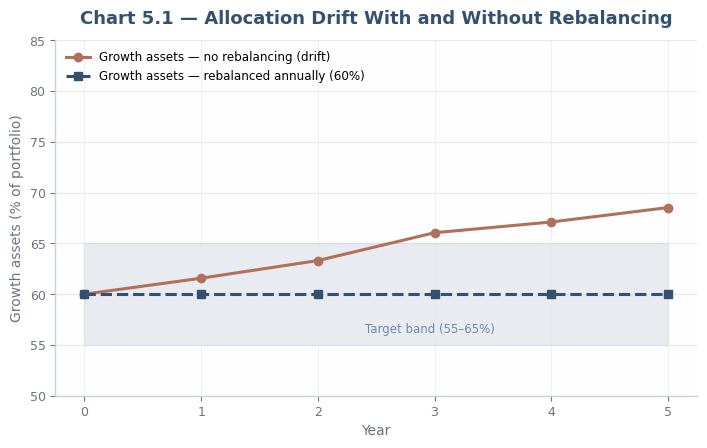
2. Rebalancing. As markets move, your allocation drifts away from target. Rebalancing — trimming what has grown overweight and topping up what has fallen behind — restores your intended risk level and systematically sells high and buys low.
Two practical methods:
| Method | How It Works | Suits |
|---|---|---|
| Calendar rebalancing | Rebalance on fixed dates (e.g. every 30 June and 31 December) | Trustees who want simplicity and a set routine |
| Threshold rebalancing | Rebalance only when an allocation moves more than ±5 percentage points from target | Trustees who want fewer trades and lower costs |
A smart hybrid: check quarterly, act only if a threshold is breached. Note also that contributions and pension payments are natural rebalancing tools — directing new contributions to underweight assets (or drawing pension payments from overweight ones) rebalances without selling, avoiding capital gains events.
Your fund targets 70% growth / 30% defensive. After a strong share market year the portfolio is $340,000 growth / $120,000 defensive — 74%/26%. The 4-point drift is within a ±5-point band, so no action is needed yet; you simply direct the next quarter’s contributions toward defensive assets. Had drift reached 76%, you would trim $18,000 from growth back to target — and, inside super’s 10% CGT environment for long-held assets, the tax cost of trimming is modest.
3. Performance evaluation. Compare the portfolio’s return against a sensible benchmark — for the core, the relevant index (e.g. S&P/ASX 200 Accumulation Index, which includes dividends); for the whole portfolio, a blended benchmark matching your allocation. Judge over rolling 3–5 year periods, not single months and always compare returns after fees and tax.
Portfolio management strategies reference
| Strategy | Description | Suggested Frequency |
|---|---|---|
| Monitoring | Review allocation, prices, announcements, income | Monthly (light) / quarterly (deep) |
| Rebalancing | Restore target allocation via trimming, topping up, or directing contributions | Quarterly check; act on threshold or calendar |
| Evaluation | Compare returns against benchmark and goals, after fees and tax | Annually (full review); 3–5 year lens |
| Strategy review | Re-confirm the written investment strategy still fits members’ needs | Annually and after major life/market events |
5.2 Understanding DRPs and Re-contribution Strategies
Dividend Reinvestment Plans (DRPs)
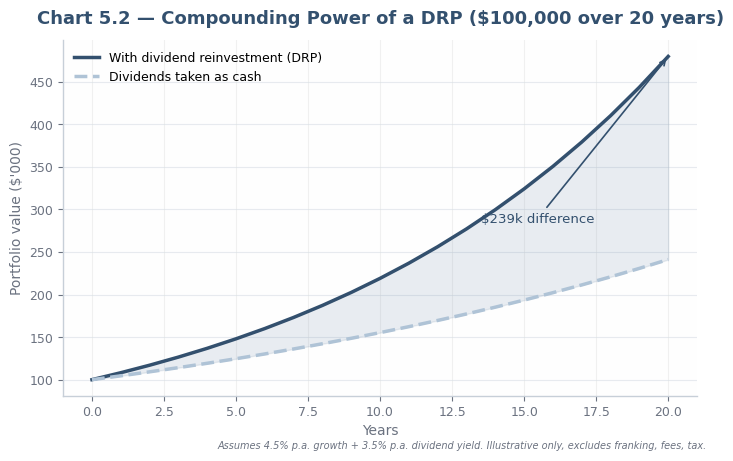
Many ASX-listed companies and ETFs offer a DRP: instead of paying your dividend in cash, the company uses it to buy you additional shares — often at a small discount to market price and always with no brokerage. For a fund in long-term accumulation, DRPs automate compounding.
Key features and cautions:
- Automatic compounding — every dividend buys more shares, which produce more dividends
- No brokerage and sometimes a 1–2% discount on the reinvestment price
- Franking is unaffected — DRP shares carry the same franking credits as cash dividends
- Tax note: DRP shares are still taxable income in the year received (the ATO treats them exactly like a cash dividend reinvested) and each DRP allotment is a new parcel with its own cost base for CGT — your administrator tracks these parcels
- Liquidity note: in or near pension phase, taking dividends as cash may suit better, because pension payments must be funded from cash
Re-contribution and Regular Contribution Strategies
Contributions are the other great lever. Within the 2026–27 caps ($32,500 concessional / $130,000 non-concessional per person), regular contributions:
- Leverage compounding — money added earlier compounds longer
- Provide natural dollar-cost averaging — steady buying through market cycles
- Fund rebalancing without selling — direct new money to underweight assets
- Exploit the caps before they reset — unused concessional cap amounts can be carried forward for up to five years if the member’s total super balance is under $500,000
Benefits of DRPs and re-contributions
| Strategy | Benefits | Watch-outs |
|---|---|---|
| DRP | Compounds returns automatically; no brokerage; possible discount; keeps franking | Creates multiple CGT parcels; dividends still taxable; reduces cash for pensions |
| Re-contribution / regular contributions | Adds fuel to compounding; dollar-cost averages; rebalances without triggering CGT; uses annual caps | Must stay within contribution caps; consider bring-forward and carry-forward rules |
Lesson 5 Summary — Key Takeaways
- Portfolios drift; rebalancing restores your intended risk and enforces sell-high/buy-low discipline
- Rebalance by calendar or threshold (±5%); use contributions and pension flows to rebalance without selling where possible
- Evaluate performance against an accumulation-index benchmark, after fees and tax, over multi-year periods
- DRPs automate compounding at zero brokerage; remember dividends remain taxable and create CGT parcels
- Regular contributions within the annual caps are the most reliable way to grow the fund — and unused concessional caps may be carried forward
Read the Dividend Reinvestment Plans article on Investopedia. Then outline your fund’s management routine: monitoring schedule, rebalancing method and threshold, benchmark choice and whether DRPs are on or off for each holding (with reasons).
Single-choice question on portfolio review frequency and rebalancing thresholds, plus a short text response outlining your DRP and contribution plan.
Finish Course Early?
You have not completed all required lessons and assessments.