

SMSF Investment Strategies & Asset Allocation SMSF Investment Strategy Diversification 📋 Contents Why Your SMSF Investment Strategy Matters Understanding Acceptable Asset Allocation Navigating High-Concentration SMSFs – The “10% Diversification Rule” Sample Asset Allocation Strategy Visual Diagram: Concentration Risk & Justification SMSF Compliance: Key ATO Requirements FAQs SEO Keyword & Meta Description 1. Why Your SMSF […]
SMSF Investment Strategies & Asset Allocation
SMSF Investment Strategy Diversification
📋 Contents
1. Why Your SMSF Investment Strategy Matters
SMSF Investment Strategy Diversification is critical to ensure that a SMSF members fund returns keep pace with other super funds to ensure that risks and returns are maintained within the acceptable guidelines to meet the needs of the funds members in the draw down phase of their lives; referred to as the pension phase; where concentration in one single asset adds risk and a glaring lack of diversity, which impact the retirement objectives of fund members.
Under Section 4.09 of the SIS Act 1993, SMSF trustees must prepare and regularly review an investment strategy that:
-
Defines risk-return objectives
-
Ensures diversification and liquidity
-
Aligns with fund liabilities (pensions/benefits)
-
Reflects overall financial circumstances
-
Mitigates key risks
Neglect risks: ATO scrutiny, compliance breaches, contravention reports, trustee disqualification.
2. Understanding Acceptable Asset Allocation
SMSF trustees may invest in diversified asset classes:
| Asset Class | Examples |
|---|---|
| Shares & Equities | ASX/global stocks, ETFs |
| Property | Residential & commercial real estate |
| Fixed Income | Bonds, term deposits |
| Cash & Equivalents | Savings, money market accounts |
| Commodities & Precious Metals | Gold, silver bullion |
| Alternative Investments | Crypto, private equity, managed funds |
3. Navigating High-Concentration SMSFs
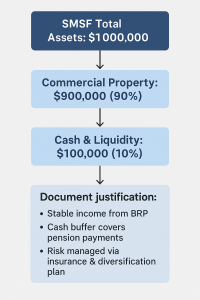
While SIS does not mandate fixed percentages, ATO focuses on funds with > 90% in a single class.
To mitigate “concentration risk,” SMSF trustees must:
-
Justify the rationale (e.g., long-term stable income)
-
Demonstrate liquidity planning (e.g., cash buffer for pensions)
-
Explain risk mitigation (insurance, locked-in rental income)
4. Sample Asset Allocation Strategy
| Asset Class | Recommended Range | Example Allocation |
|---|---|---|
| Shares | 20%–40% | 30% |
| Property | 20%–60% | 50% |
| Fixed Income | 10%–30% | 10% |
| Cash Equivalents | 5%–20% | 10% |
| Alternatives | 5%–15% | 0% |

This balanced approach supports compliance, flexibility and growth.
5. 📊 Concentration Risk & Justification
6. SMSF Compliance: Key ATO Requirements
-
Regular Strategy Reviews
-
Reassess at least annually or after major events.
-
Document every change with rationale.
-
-
Liquidity & Risk Management
-
Hold sufficient cash/fixed income.
-
Manage liquidity for benefit payments and market shifts.
-
-
Record Keeping
-
Trustee minutes for investment decisions.
-
Supporting documents ready for audit.
-
7. FAQs
✅ 1. What if my SMSF ends up 95% in property?
You must justify the concentration via well-documented strategy, liquidity planning and risk measures. Without this, breaches may occur.
✅ 2. Are asset allocation bands allowed under SIS?
Yes, but only if they are reasonable, with clear justification—arbitrary bands can trigger auditor or ATO scrutiny.
✅ 3. How often should the strategy be reviewed?
At least annually, or after significant changes (e.g., market plunges, retirement, asset acquisitions/sales).
ADDITIONAL RESOURCES:
- ATO – Diversification Guidelines
- MySMSF – Shares and Franking Credits
Note: Auditors discourage SMSFs fund trustee/members from setting asset allocation ranges, unless there is sound reasoning for this. Investment strategies should be updated annually to demonstrate active involvement of SMSF trustee, members in managing the fund assets.
Conclusion: Securing Your SMSF’s Long-term Success
SMSF Investment Strategy Diversification is a critical ingredient in the effective management of an SMSF, to ensure return and risks are within acceptable limits to meet the fund members objectives. Documenting and regularly reviewing an investment strategy is crucial to a SMSF’s success and compliance. Ensure you clearly justify asset concentrations, particularly if exceeding the informal “10% diversification rule.” SMSF members should consider proactive management to not only satisfy the ATO but also to position your SMSF to deliver optimal retirement benefits. By taking these careful steps, your SMSF remains both compliant and strategically optimized, safeguarding your financial future.
Warning: General Information.
This article has been published for general guidance purposes for My SMSF members. It is not a substitute for financial advice.