

SMSF Cryptocurrency Course
Secure your spot for $22 (once-off). After payment, we’ll email your login and unlock all lessons and the certificate.
You’re viewing a locked lesson preview. Purchase unlocks all 8 lessons, quizzes and the certificate.
Before your fund invests a single dollar, you need to understand what you are actually buying. In this lesson you will learn what cryptocurrency is, how blockchain technology works, why Bitcoin and Ethereum dominate the market and how crypto generates (and destroys) value. By the end you will be able to explain crypto to a fellow trustee in plain English — a surprisingly good test of whether you are ready to invest.
- Define cryptocurrency and explain how a blockchain records transactions
- Describe the roles of Bitcoin, Ethereum, stablecoins and other crypto assets
- Explain how crypto is stored (public addresses, private keys, wallets)
- Identify what drives crypto value — and volatility
Estimated time: 60 minutes
1.1 What Is Cryptocurrency and How Does Blockchain Work?
Cryptocurrency in Plain English
A cryptocurrency is a digital asset that exists only on a blockchain — a shared, public database maintained by thousands of computers around the world rather than by any bank, company or government. Ownership is recorded on this ledger and transactions are verified by the network according to rules written in software. There is no central authority to reverse a payment, freeze an account, or print more coins beyond the protocol’s rules.
How a transaction works. You instruct your wallet to send crypto to another address; the transaction is broadcast to the network; thousands of independent computers (nodes) verify your digital signature and balance; validators or miners bundle it into a new “block” added to the chain; once confirmed, the recipient’s wallet shows the funds. The whole process is visible to anyone on a public block explorer — which, as Lesson 6 shows, is exactly how auditors can verify your fund’s holdings.
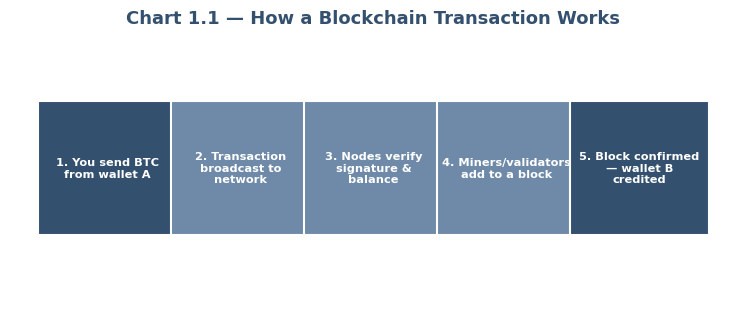
The Key Concepts Every Trustee Must Know
| Term | Plain-English Meaning | Why It Matters for an SMSF |
|---|---|---|
| Blockchain | A public, append-only ledger maintained by a network | Transactions are traceable forever — good for audit trails |
| Public address | Your account number on the blockchain — safe to share | Listed in your fund’s records for auditor verification |
| Private key | The secret password that controls the address | Whoever holds the key controls the crypto — custody is everything |
| Wallet | Software or hardware that stores keys and signs transactions | Must be held solely for the fund (Lesson 3) |
| Seed phrase | 12–24 words that can regenerate all keys | The master key — lose it and the fund’s crypto is gone forever |
| Gas / network fee | The fee paid to the network to process a transaction | A deductible cost in your tax records |
| Confirmation | A block added after your transaction | Final settlement — there is no chargeback or reversal |
Not your keys, not your coins. If crypto sits on an exchange, the exchange holds the private keys — you hold an IOU. If crypto sits in your own wallet, you hold the keys — and full responsibility. This trade-off between control and convenience runs through the entire course and is settled for most SMSFs with a blend: exchange accounts for trading, a hardware cold wallet for long-term storage.
1.2 The Crypto Landscape: Bitcoin, Ethereum and Everything Else
The Major Categories
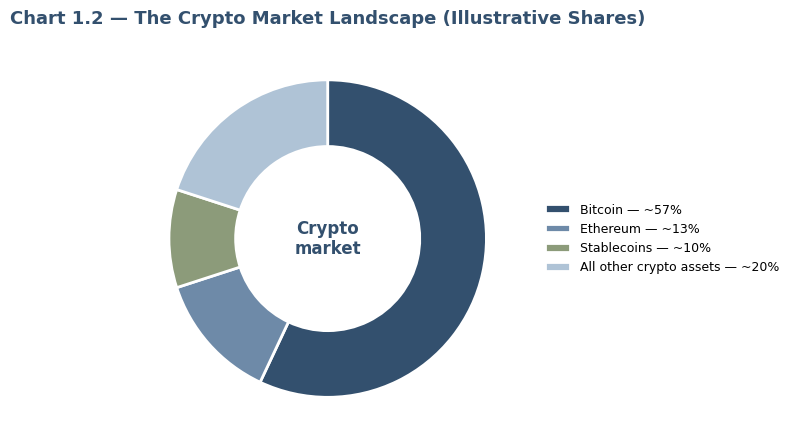
Bitcoin (BTC) — the original cryptocurrency (2009), with a hard cap of 21 million coins. Its investment case is “digital gold”: a scarce, censorship-resistant store of value. Bitcoin dominates the market and is the most common SMSF crypto holding.
Ethereum (ETH) — a programmable blockchain on which thousands of applications (DeFi, tokenisation, NFTs) are built. Its investment case is “digital infrastructure”: demand for ETH is linked to use of the network.
Stablecoins (e.g. USDT, USDC) — tokens pegged to currencies like the US dollar, used for moving value between trades. Useful operationally, but they pay no yield by themselves and carry issuer/depeg risk.
Everything else (“altcoins”) — thousands of smaller tokens, from legitimate infrastructure projects to outright jokes and scams. Volatility and failure rates are extreme; most SMSF trustees should treat this category as uninvestable speculation unless they have deep expertise.
Crypto Asset Categories — SMSF Suitability Overview
| Category | Examples | Role | Typical SMSF View |
|---|---|---|---|
| Store of value | Bitcoin | Long-term scarce asset | Core crypto holding for most funds |
| Smart-contract platforms | Ethereum | Network/infrastructure exposure | Secondary holding for many funds |
| Stablecoins | USDC, USDT | Trading liquidity, transfers | Operational tool, not an investment |
| Altcoins / memecoins | Thousands of small tokens | Speculation | Generally outside prudent SMSF strategy |
What Drives Value — and Volatility
Crypto has no dividends, no rent and no earnings. Its price is driven by supply (fixed or programmed issuance), demand (adoption, institutional flows, listed ETFs), sentiment and liquidity. That produces volatility several times that of share markets: drawdowns of 50–80% have occurred multiple times in Bitcoin’s history — even as long-run holders have been rewarded. Lesson 7 turns this reality into position-sizing rules; for now, the takeaway is simple: size any crypto allocation so that a 70% fall would not damage the fund’s retirement plans.
Trustees who want crypto exposure without wallets and keys can also consider ASX/Cboe-listed spot Bitcoin and Ethereum ETFs, held through the fund’s ordinary share broker. These trade custody simplicity for a management fee and remove self-custody control — the course focuses on direct ownership, but Lesson 7 compares the two paths.
Lesson 1 Summary — Key Takeaways
- Crypto lives on a blockchain: a public ledger with no central operator and no transaction reversals
- Public addresses can be shared; private keys and seed phrases must never be — they are the asset
- Bitcoin (digital gold) and Ethereum (digital infrastructure) dominate; stablecoins are tools; small altcoins are speculation
- Every transaction is permanently visible on a block explorer — the foundation of crypto audit evidence
- Crypto pays no income and is deeply volatile; allocation sizing (Lesson 7) is what makes it survivable in a retirement portfolio
Open a public block explorer (e.g. mempool.space for Bitcoin or etherscan.io for Ethereum) and look up any transaction. Identify the sender address, receiver address, amount and fee. Write two sentences explaining what you see, in plain English.
Five multiple-choice questions on blockchain basics, keys and wallets and the major crypto categories. Pass mark: 80%.
Finish Course Early?
You have not completed all required lessons and assessments.