
SMSF Cryptocurrency Course
Secure your spot for $22 (once-off). After payment, we’ll email your login and unlock all lessons and the certificate.
You’re viewing a locked lesson preview. Purchase unlocks all 8 lessons, quizzes and the certificate.
Every SMSF is audited every year — and crypto is where unprepared funds come unstuck. The good news: crypto can be audited just as smoothly as shares or property if you know what the auditor needs and collect it continuously. This lesson turns the ATO’s requirements into a practical evidence pack you maintain as you go, so audit season is a formality rather than a scramble.
- Explain the three pillars of an SMSF crypto audit: ownership, transactions, valuation
- Assemble the complete evidence pack for exchange-held and wallet-held crypto
- Provide objective 30 June market valuations that satisfy the ATO standard
- Avoid the common findings that lead to qualified audits
Estimated time: 45 minutes
6.1 The Three Pillars of a Crypto Audit
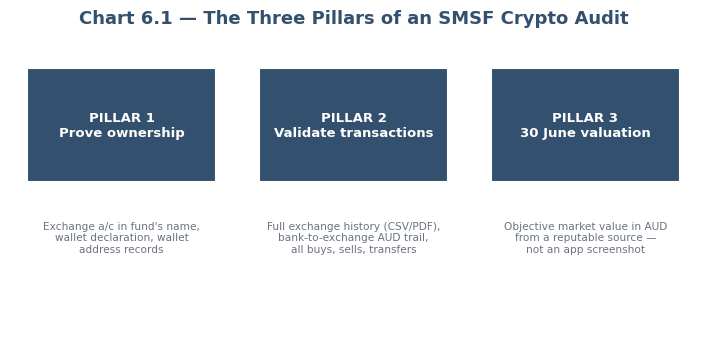
Your auditor’s work boils down to three questions. Prepare clear evidence for each and the audit is smooth.
Pillar 1 — Prove ownership
The auditor must be satisfied the fund owns the crypto, not you personally. Evidence: exchange account registration in the fund’s legal name; the list of fund wallet addresses; and for hardware wallets, a signed trustee declaration that the device and its contents are held wholly and exclusively for the fund, noting where it is stored. Blockchain transparency helps here — the fund’s addresses show their balances publicly and records linking those addresses to the fund’s exchange withdrawals create a clear chain of ownership.
Pillar 2 — Validate every transaction
The auditor traces the complete, unbroken trail: AUD leaving the fund’s bank account, arriving at the exchange, converting to crypto and (where applicable) moving to the fund’s wallet. Evidence: full financial-year transaction history from every exchange (CSV/PDF), fund bank statements, trade confirmations and withdrawal TXIDs. Any gap — a deposit from an unknown source, an unexplained wallet — breaks the chain.
Pillar 3 — Value at 30 June
All fund assets must be reported at market value. The ATO has been explicit: holding statements or app screenshots alone are not sufficient evidence. Use an objective source — the 30 June closing price in AUD published by a reputable exchange with historical data, or a report from a recognised data provider — and keep the extract in the audit file.
6.2 The Audit Evidence Pack — Your Checklist
Assemble this continuously through the year:
Mixing personal and fund wallets or accounts; missing transaction history; inability to prove key control; an investment strategy that never mentions crypto; and 30 June values supported only by screenshots. Any of these, if material, means a qualified audit — and potentially an Auditor Contravention Report to the ATO.
Because our administration connects by API to the six supported exchanges and includes coin audit tools that verify wallet holdings against the blockchain, much of this evidence pack is produced automatically — ownership records, transaction feeds and 30 June valuations generated from verified data rather than manual collection.
Lesson 6 Summary — Key Takeaways
- Audits test three things: ownership, complete transactions and objective 30 June valuation
- Cold wallets need a signed trustee declaration plus recorded public addresses; the blockchain itself is your ally
- Screenshots are not valuation evidence — use published closing prices from a reputable source
- Build the evidence pack continuously; reconciliation monthly, not in June
- API-integrated exchanges and coin audit tools turn evidence collection into a data feed
Self-audit your fund against the checklist above (or your intended fund setup). List every item you could produce today and every gap you would need to close before 30 June.
Single-choice questions on audit evidence standards, plus submission of your completed evidence-pack gap analysis.
Finish Course Early?
You have not completed all required lessons and assessments.