

SMSF Cryptocurrency Course
Secure your spot for $22 (once-off). After payment, we’ll email your login and unlock all lessons and the certificate.
You’re viewing a locked lesson preview. Purchase unlocks all 8 lessons, quizzes and the certificate.
Crypto’s volatility is the price of its potential — and inside a retirement fund it must be managed deliberately. This lesson covers how much crypto a prudent SMSF should hold, how to build the position with dollar-cost averaging, how to protect it with rebalancing and exit rules and how to recognise the scams that target trustees. The goal: capture the upside, survive the downside and never let a crypto position threaten the fund’s core purpose.
- Size a crypto allocation using volatility-aware rules
- Apply dollar-cost averaging and rebalancing to a crypto sleeve
- Set exit rules for both profits and losses
- Identify and avoid the major scam types targeting Australian investors
Estimated time: 60 minutes
7.1 Sizing the Allocation — the Volatility Reality
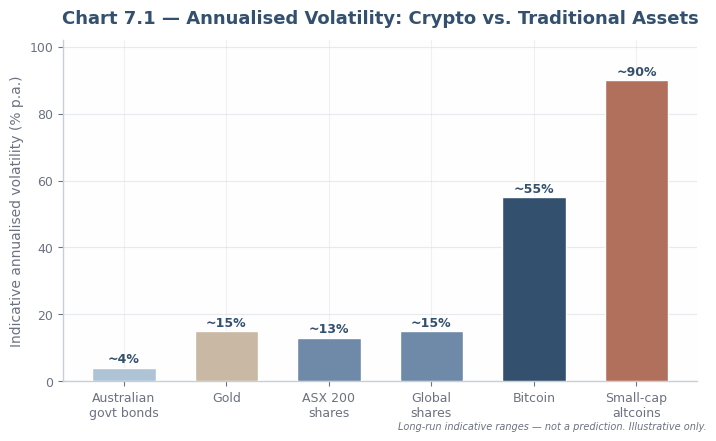
The chart below makes the point bluntly: Bitcoin’s annualised volatility runs several times that of share markets and smaller altcoins are wilder still. Drawdowns of 50–80% have occurred repeatedly in crypto’s history. The correct response is not avoidance — it is sizing.
Decide the maximum drawdown the fund could tolerate from crypto without threatening retirement plans, then work backwards. If crypto might fall 70% and the fund can tolerate a 3.5% portfolio hit, the crypto cap is 5% (5% × 70% ≈ 3.5%). For most SMSFs, a 1–5% allocation is the prudent range: large enough to matter if crypto performs, small enough to be survivable if it collapses. Record the cap in the investment strategy and stick to it.
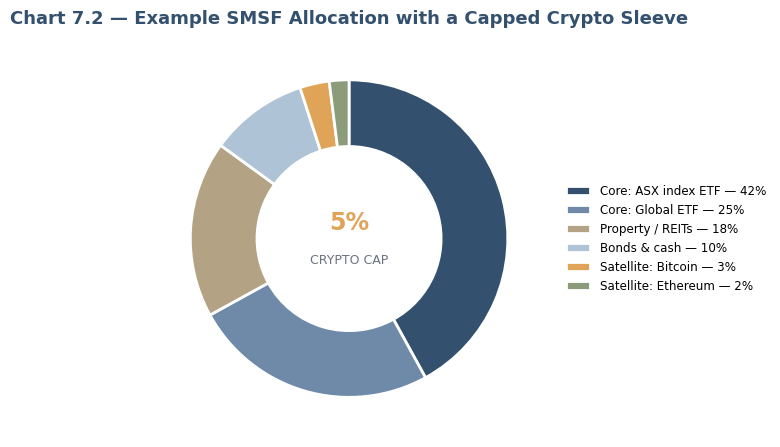
Direct crypto vs listed crypto ETFs
| Factor | Direct (wallet/exchange) | ASX/Cboe-listed spot crypto ETFs |
|---|---|---|
| Custody | You control keys (cold wallet) | Fund manager/custodian holds keys |
| Fees | Trading + network fees only | Management fee (MER) plus brokerage |
| Effort/compliance | Wallet declarations, TXIDs, address lists | Ordinary share records (CHESS/HIN) |
| Trading hours | 24/7 | Market hours only |
| Suits | Trustees wanting control and direct ownership | Trustees wanting simplicity via existing broker |
Many funds use listed ETFs for a first, simple exposure and graduate to direct ownership as skills grow — either path is legitimate if documented in the strategy.
7.2 Building and Managing the Position
Dollar-cost averaging (DCA). Given crypto’s volatility, entering in instalments is near-essential. A fixed AUD amount monthly or quarterly — via recurring-buy features on the fund’s exchange account — buys more coins when prices are low and fewer when high, removing the impossible task of timing the market. Batch frequency vs. fees: monthly usually balances both.
Rebalancing the sleeve. Crypto’s swings will push it outside its target range quickly. Set a threshold rule: if crypto exceeds its cap by more than 2 percentage points (say 5% → 7%), trim back to target — which enforces sell-high discipline — and record the CGT outcome. If it falls well below, top up only if the thesis and strategy still hold, never to “average down” blindly.
Exit rules (write them before buying)
| Rule Type | Example for an SMSF |
|---|---|
| Profit-taking | Trim to target allocation whenever the cap is breached; bank gains into the core portfolio |
| Thesis review | Exit if the fundamental case breaks (protocol failure, regulatory prohibition) — regardless of price |
| Liquidity rule | Crypto is never counted on for near-term pension payments or fund expenses |
| Time rule | Reassess the allocation formally at every annual strategy review |
Note that traditional stop-loss orders are of limited use in crypto: 24/7 markets gap through stops and wicked volatility triggers them constantly. Allocation caps and rebalancing are the SMSF-appropriate equivalents.
7.3 Scams and Threats — the Trustee's Defence
Crypto attracts sophisticated fraud. The patterns to recognise instantly:
| Scam | How It Works | Defence |
|---|---|---|
| Phishing | Fake exchange/wallet emails and sites stealing logins or seed phrases | Bookmark official sites; never enter seeds anywhere; verify URLs |
| Fake support | “Support agents” call or DM asking for seed phrases or remote access | Real support never asks for seeds or screen-sharing — hang up |
| Pig butchering | Online relationship builds trust, then steers you to a fake investment platform | No stranger’s platform; if returns are “guaranteed”, it’s a scam |
| Rug pulls / fake tokens | Hyped new tokens whose creators vanish with the money | Stick to established assets on registered exchanges |
| Recovery scams | Victims of one scam are targeted again by fake “recovery agents” | Report to Scamwatch; never pay to “recover” funds |
| Deepfake endorsements | Fabricated celebrity/public-figure crypto promotions | Verify via official channels; treat all celebrity crypto ads as hostile |
(1) the seed phrase is never shared, typed or photographed; (2) no legitimate party guarantees returns; (3) if contacted about crypto out of the blue — by call, text, email or DM — assume it is a scam until proven otherwise.
Lesson 7 Summary — Key Takeaways
- Size for a 70% drawdown: a 1–5% allocation captures upside without threatening the fund
- Dollar-cost average entries; crypto punishes lump-sum bravado
- Rebalance with thresholds — crypto’s swings enforce the discipline automatically
- Write exit rules before buying; don’t count crypto toward pension liquidity
- Know the scam patterns; the seed phrase never leaves your custody
Calculate your fund’s crypto cap using the drawdown method, draft your DCA schedule (amount, frequency, exchange) and write your three exit rules. Note how each will be minuted.
Multiple-choice questions on sizing, DCA and scam identification. Pass mark: 80%.
Finish Course Early?
You have not completed all required lessons and assessments.