

SMSF Cryptocurrency Course
Secure your spot for $22 (once-off). After payment, we’ll email your login and unlock all lessons and the certificate.
You’re viewing a locked lesson preview. Purchase unlocks all 8 lessons, quizzes and the certificate.
In crypto, custody is ownership. Whoever controls the private keys controls the assets — there is no bank to call, no password reset, no fraud department. This lesson covers the three custody options, why most SMSFs settle on a hardware cold wallet (such as Ledger) for long-term holdings and the security practices that protect the fund’s keys and seed phrases from theft, loss and disaster.
- Compare exchange custody, hot wallets and cold wallets on security and convenience
- Set up a hardware wallet correctly for fund use
- Manage seed phrases with backup, storage and succession planning
- Apply everyday security hygiene to all fund crypto operations
Estimated time: 60 minutes
3.1 Custody Options Compared
The Three Ways to Hold Crypto
1. Exchange custody. The crypto stays in the fund’s exchange account; the exchange holds the keys. Maximum convenience for trading, but you carry counterparty risk — exchange hacks, freezes and collapses (FTX being the famous lesson) can trap or destroy holdings. Suitable for amounts you are actively trading, not for long-term storage.
2. Hot wallet (software). An app on a phone or computer holds the keys. You control the keys, but the device is internet-connected, so malware and phishing remain threats. Suitable for small, operational amounts only.
3. Cold wallet (hardware). A dedicated offline device (e.g. Ledger) stores keys that never touch the internet; transactions are signed on the device itself. The strongest practical security available to an SMSF — and the standard for long-term fund holdings.
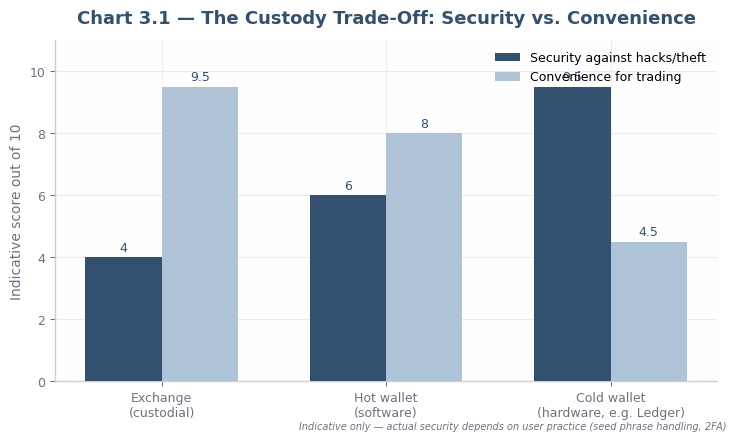
Custody Options — Full Comparison
| Factor | Exchange Custody | Hot Wallet | Cold Wallet (Ledger) |
|---|---|---|---|
| Who holds keys | The exchange | You (on connected device) | You (on offline device) |
| Hack/theft exposure | Exchange-level breaches | Malware, phishing | Very low (offline signing) |
| Trading convenience | Instant | Moderate | Must connect device |
| Recovery if lost | Exchange support process | Seed phrase | Seed phrase + new device |
| Audit evidence | Account statements in fund name | Wallet addresses + declaration | Wallet addresses + trustee declaration |
| Best SMSF use | Active trading balance | Small operational amounts | Long-term core holdings |
Whichever option you use, it must be exclusively for the fund: a hardware wallet purchased with fund money, initialised fresh, used only for fund crypto and documented with a signed trustee declaration confirming the wallet and its contents are held wholly and solely for the fund — including where the device is stored and how it is secured.
3.2 Setting Up and Protecting a Hardware Wallet
Setup Done Right
- Buy direct from the manufacturer (never second-hand or from marketplaces — devices can be tampered with), paid for from the fund’s bank account
- Initialise as a new wallet — the device generates a fresh seed phrase; never use a pre-filled card
- Write the seed phrase on paper/steel — never photograph it, type it, email it or store it in any digital form
- Set a strong device PIN and record the fund’s public addresses in trustee minutes
- Test with a small amount first — send a small transfer, confirm receipt on a block explorer, then move the balance
- Update firmware only via the manufacturer’s official software
Seed Phrase Discipline — the Master Key
The seed phrase can regenerate every key on the device. Protect it accordingly:
| Do ✅ | Never 🚩 |
|---|---|
| Store written copies in two separate secure locations (e.g. safe + bank deposit box) | Store digitally — photos, cloud, email, notes apps, password managers |
| Consider a steel backup plate for fire/flood resistance | Share it with anyone — no support agent ever needs it |
| Tell your executor/enduring power of attorney where instructions are (not the phrase itself) | Enter it into any website — that is always a scam |
| Include wallet access in the fund’s succession plan | Keep the only copy in the same place as the device |
If the sole trustee dies or loses capacity and nobody can access the wallet, the members’ retirement savings are permanently gone. Document the access procedure (securely) so a replacement trustee can lawfully take control — your estate planning lawyer can help structure this.
Everyday Security Hygiene
- Two-factor authentication on every exchange account (authenticator app, not SMS)
- Unique, strong passwords via a reputable password manager
- Beware phishing — check URLs character by character; bookmark official sites; never click wallet/exchange links in emails or DMs
- Verify addresses when withdrawing — check the first and last six characters on the hardware device screen itself
- Small test transfer before any large movement to a new address
- Dedicated email address for the fund’s crypto accounts, not your everyday inbox
Lesson 3 Summary — Key Takeaways
- Custody is ownership: exchange for trading balances, cold wallet for long-term holdings, hot wallet only for small operational amounts
- The fund’s wallet must be exclusively for the fund, bought with fund money and covered by a signed trustee declaration
- The seed phrase is the master key — paper/steel copies in separate secure locations, never digital, never shared
- Test small first on any new wallet or address; verify addresses on the device screen
- Plan for succession — crypto without an access plan can die with the trustee
Draft your fund’s custody policy: which custody method for what purpose, where the device and seed backups are stored, who can access them and the succession procedure. (Do not include actual seed words anywhere.)
Multiple-choice questions on custody options, seed phrase handling and security hygiene. Pass mark: 80%.
Finish Course Early?
You have not completed all required lessons and assessments.