

SMSF Cryptocurrency Course
Secure your spot for $22 (once-off). After payment, we’ll email your login and unlock all lessons and the certificate.
You’re viewing a locked lesson preview. Purchase unlocks all 8 lessons, quizzes and the certificate.
This is the lesson that separates a compliant SMSF crypto investor from an expensive cautionary tale. Crypto is a permitted SMSF investment — but only within a framework of rules that your auditor will test every year. In this lesson you will build that framework before investing: trust deed permission, investment strategy updates, trustee resolutions and the separation-of-assets rule that causes more crypto audit failures than anything else.
- Confirm crypto is permitted under your fund’s trust deed and investment strategy
- Apply the sole purpose test and separation-of-assets rule to digital assets
- Prepare the trustee documentation that evidences compliant decision-making
- Understand what auditors check, per ATO guidance, before you invest
Estimated time: 60 minutes
2.1 The Rules That Apply to SMSF Crypto
Rule 1 — The Trust Deed Must Permit It
Your fund’s trust deed is its rulebook. Most modern deeds permit a wide range of investments including crypto, but older deeds may not mention digital assets. Action: check the deed’s investment powers clause; if silent or restrictive, have the deed updated before investing. Your My SMSF team can arrange this.
Rule 2 — The Investment Strategy Must Cover It
The SIS Act requires trustees to formulate, review regularly and give effect to a written investment strategy considering risk, return, diversification, liquidity and the fund’s ability to pay benefits. For crypto, the strategy should state:
- That crypto assets are a permitted asset class, with target and maximum allocation ranges (e.g. 0–5%)
- The rationale — why crypto fits the members’ objectives and risk tolerance
- The specific risks considered: volatility, custody, regulatory change, liquidity, scams
- The custody approach — exchange accounts and/or a hardware wallet held for the fund
- Liquidity — how the fund will still meet pension payments and expenses without forced selling
An outdated strategy that never mentions crypto is one of the most common crypto audit findings — and one of the easiest to fix.
Rule 3 — The Sole Purpose Test
The fund must be maintained solely to provide retirement benefits. For crypto this means: the fund invests for retirement outcomes — not for a trustee’s hobby trading, not to get early access to assets and never with any personal benefit flowing to members or related parties. Buying crypto through the fund and “borrowing” it personally, staking it for personal reward, or parking fund crypto in a personal wallet all fail this test.
Rule 4 — Separation of Assets (The Big One)
Fund assets must be held separately from trustees’ personal assets. For crypto, regulators and auditors apply this strictly:
| Compliant ✅ | Breach 🚩 |
|---|---|
| Exchange account registered in the SMSF’s legal name | Trading fund crypto through a trustee’s personal exchange account |
| Hardware wallet used wholly and exclusively for the fund, declared in writing | One Ledger device holding both personal and fund crypto |
| AUD flows: fund bank account → fund exchange account only | Personal money mixed into the fund’s exchange account (or vice versa) |
| Dedicated wallet addresses recorded in fund minutes | Reused/shared addresses with personal transactions in the history |
If a wallet or account is in an individual’s name and that individual is also a trustee, it can be impossible to prove the fund owns the asset — leading to a qualified audit and potentially the crypto being treated as a personal asset, with tax and contravention consequences.
What the ATO Tells Auditors to Check
Per the ATO’s guidance on auditing SMSFs with crypto assets, the auditor must confirm the investment:
- Is permitted under the fund’s trust deed
- Aligns with the investment strategy, with risks and retirement goals considered
- Is held and owned by the fund — a wallet in the fund’s name, separate from personal crypto
- Is reported at market value — with objective evidence, not just a holding statement or screenshot
Failure to verify any of these, where material, means a qualified audit report (Parts A and B) and potentially an Auditor Contravention Report to the ATO.
2.2 Your Pre-Investment Setup — Step by Step
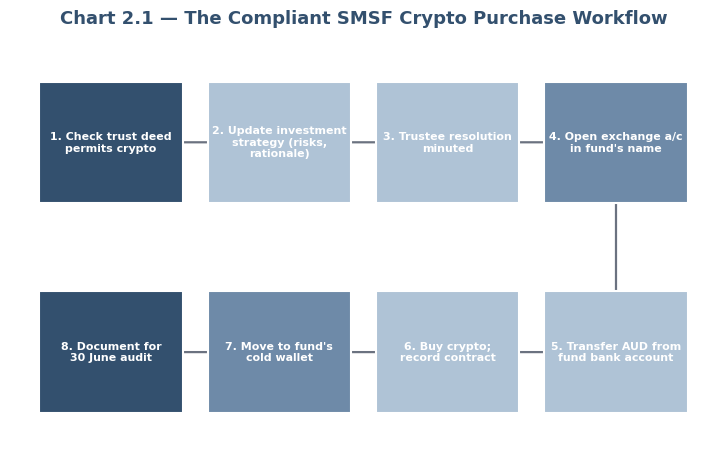
Follow this sequence in order — each step creates the evidence the next one relies on:
- Trust deed check/upgrade — confirm digital assets are within investment powers
- Investment strategy update — add crypto with allocation ranges, rationale, risks, custody approach
- Trustee resolution and minutes — all trustees sign a resolution recording the decision to invest, the assets chosen, the allocation cap and the custody plan
- Exchange account in the fund’s name — full legal fund name (e.g. “The Trustee for XYZ Super Fund”), fund ABN/TFN, trustee ID verification
- Fund cash only — transfers to the exchange come from the SMSF bank account and nowhere else
- Purchase and record — keep order confirmations, contract notes and timestamps
- Custody decision — hold on exchange for active trading or withdraw to the fund’s dedicated hardware wallet for long-term holding (Lesson 3)
- Document for audit — maintain the evidence pack continuously, not in a panic each June (Lesson 6)
“Resolved: that the fund invest up to 3% of fund assets in Bitcoin and up to 2% in Ethereum, purchased through the fund’s account with [Exchange], transferred from the fund’s bank account; that long-term holdings be secured in the Ledger hardware wallet purchased by and held exclusively for the fund; and that the investment strategy is updated accordingly. The trustees have considered the volatility, custody, regulatory and liquidity risks and are satisfied the investment supports the members’ retirement objectives.”
Sign, date, file.
Lesson 2 Summary — Key Takeaways
- Crypto is a permitted SMSF investment — but only inside the rules: deed, strategy, sole purpose, separation
- Update the investment strategy to name crypto, set allocation ranges and record the risk assessment
- Separation of assets is the number-one crypto audit failure: fund accounts, fund wallets, fund money — always
- The ATO expects auditors to verify deed permission, strategy alignment, fund ownership and market value — or qualify the audit
- Complete the eight-step setup in order and minute everything before the first purchase
Review your fund’s trust deed investment powers and current investment strategy. Draft the crypto paragraph you would add to the strategy (asset class, allocation range, rationale, key risks, custody approach) and the trustee resolution minuting your first intended purchase.
Single-choice questions on the sole purpose test and separation of assets, plus submission of your draft strategy paragraph and resolution.
Finish Course Early?
You have not completed all required lessons and assessments.