

SMSF Cryptocurrency Course
Secure your spot for $22 (once-off). After payment, we’ll email your login and unlock all lessons and the certificate.
You’re viewing a locked lesson preview. Purchase unlocks all 8 lessons, quizzes and the certificate.
This is the practical lesson: how fund cash becomes fund crypto. You will learn how to choose and open an exchange account in the fund’s name, move AUD safely, place orders, manage fees, withdraw to cold storage and keep every step documented. We also cover the six exchanges that integrate with My SMSF administration via API — which turns year-end reporting from a nightmare into a data feed.
- Select an appropriate AUSTRAC-registered exchange and open an account in the fund’s legal name
- Execute AUD deposits, crypto purchases and wallet withdrawals with a clean audit trail
- Understand trading fees, spreads and network fees
- Connect exchange APIs to fund administration for automated reporting
Estimated time: 60 minutes
4.1 Choosing an Exchange and Opening the Fund's Account
Selection Criteria
| Criterion | What to Look For |
|---|---|
| Registration | Registered with AUSTRAC as a digital currency exchange — non-negotiable for an SMSF |
| Entity accounts | Accepts SMSF/trust accounts with proper fund documentation |
| AUD rails | Direct AUD deposits/withdrawals (PayID/bank transfer) |
| Asset range & liquidity | Deep order books in BTC/ETH at minimum |
| Fees | Transparent trading fees and spreads (see below) |
| Reporting | CSV/PDF tax reports and API access for fund administration |
| Security | 2FA, withdrawal whitelisting, cold-storage of client assets, insurance fund |
My SMSF administration connects via API to six exchanges — Binance, Kraken, CoinSpot, Coinbase, KuCoin and Bitaroo — allowing holdings and transactions to flow directly into your fund’s accounts. Using one of these with API access enabled means valuations, transaction histories and audit reports can be produced from verified data rather than manual downloads.
Opening the Account — Get the Name Right
The account must be registered in the fund’s exact legal name — e.g. “ABC Pty Ltd as trustee for the Smith Super Fund” — with the fund’s ABN and TFN, trustee company details and trust deed supplied at onboarding. An account in an individual’s name, even if “used for the fund”, breaks separation of assets (Lesson 2) and creates an ownership dispute your auditor cannot clear.
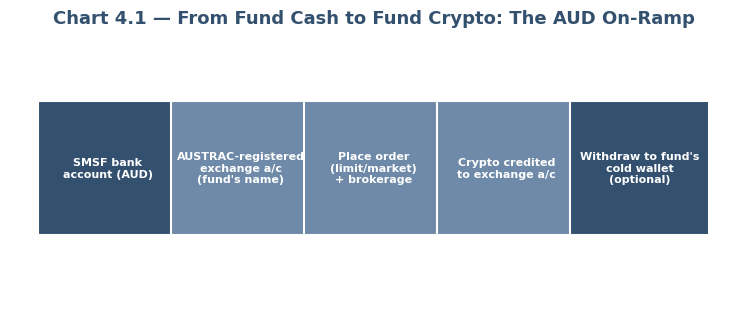
The AUD On-Ramp — Step by Step
- Transfer AUD from the SMSF bank account to the fund’s exchange account (PayID/bank transfer). Never from a personal account.
- Place the order — for size, use a limit order (you name the price) rather than a market order, especially in fast markets. Record the order confirmation.
- Settlement — crypto credits to the exchange account; download/save the trade confirmation immediately.
- Withdraw to cold storage (for long-term holdings) — whitelist the fund’s wallet address, send a small test amount, verify on the block explorer, then send the balance. Record the transaction ID (TXID).
- File everything — deposit receipt, trade confirmation, withdrawal TXID — into the fund’s records as you go.
4.2 Costs, Order Types and Practical Traps
The Three Costs of Every Trade
| Cost | What It Is | How to Minimise |
|---|---|---|
| Trading fee | Exchange commission (typically 0.1%–1% depending on platform and order type) | Use low-fee platforms; limit orders often cheaper than instant-buy |
| Spread | Gap between buy and sell prices | Trade liquid pairs (BTC/AUD, ETH/AUD) in normal hours |
| Network (gas) fee | Blockchain fee on withdrawals | Batch withdrawals; avoid congestion peaks; compare network options where supported |
Trading fee 0.5% ($50), spread ≈0.2% ($20), withdrawal network fee $5: total friction ≈ $75 (0.75%). Round-trip (buy now, sell later) roughly doubles it. Lesson 7’s dollar-cost averaging works best when contributions are batched into fewer, larger trades to keep percentage costs down.
Order Types Refresher
- Market order — fills immediately at the best available price; fine for small, liquid trades
- Limit order — fills only at your price or better; the disciplined default
- Recurring buy (auto-DCA) — many exchanges automate scheduled purchases; excellent for Lesson 7’s accumulation strategy and every purchase is still individually recorded for tax
Practical Traps to Avoid
- Crypto-to-crypto swaps are taxable — swapping BTC for ETH is a disposal of BTC (CGT event), not a like-for-like exchange (Lesson 5)
- Personal funds must never touch the account — top-ups from the wrong bank account contaminate the audit trail
- Withdrawal typos are forever — crypto sent to a wrong address is unrecoverable; test first, always
- Staking/earn products offered by exchanges may conflict with your strategy and add tax complexity — take advice before enabling them (Lesson 5)
Lesson 4 Summary — Key Takeaways
- Use an AUSTRAC-registered exchange with entity accounts, AUD rails, strong reporting and API access
- The account name must be the fund’s exact legal name — anything less breaks separation
- Every purchase follows the chain: fund bank → fund exchange → fund wallet, each step evidenced
- Costs are fee + spread + network fee; batch trades to keep percentages down
- API-connected exchanges (Binance, Kraken, CoinSpot, Coinbase, KuCoin, Bitaroo) feed My SMSF administration automatically — use them
Compare two exchanges from the API-integrated list on fees, asset range and reporting. Note which you would choose for your fund and why, then trace the full documentation trail for a hypothetical $5,000 BTC purchase withdrawn to cold storage.
Multiple-choice questions on account naming, order types and trading costs, plus a short text response on your chosen exchange.
Finish Course Early?
You have not completed all required lessons and assessments.