

SMSF Cryptocurrency Course
Secure your spot for $22 (once-off). After payment, we’ll email your login and unlock all lessons and the certificate.
You’re viewing a locked lesson preview. Purchase unlocks all 8 lessons, quizzes and the certificate.
Crypto tax trips up more trustees than any other topic — because the rule that surprises everyone is this: almost everything you do with crypto is a taxable event. Selling, swapping, spending, even gifting — each triggers capital gains tax calculations in Australian dollars. This lesson gives you the complete map: what’s a CGT event, how the 12-month discount works inside super, what counts as income and the record-keeping system that makes your annual return straightforward.
- Identify every type of CGT event in crypto — including crypto-to-crypto swaps
- Apply the 15%/10%/0% fund tax rates and the one-third CGT discount
- Distinguish capital events from income events (staking rewards, airdrops)
- Maintain ATO-compliant records for every transaction
Estimated time: 60 minutes
5.1 How the ATO Taxes Crypto in an SMSF
Crypto Is a CGT Asset
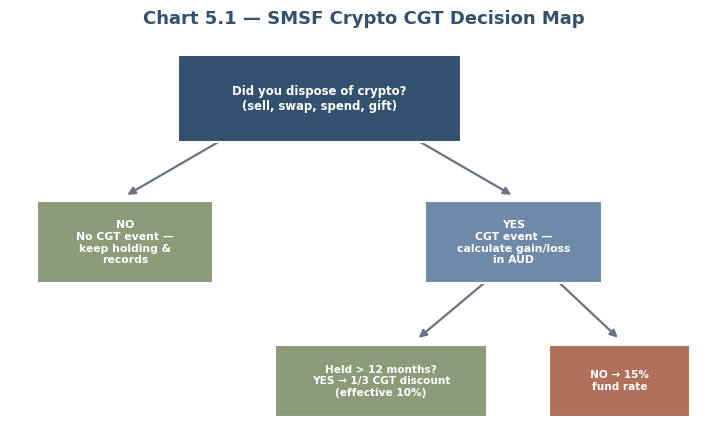
The ATO treats cryptocurrency as property — a CGT asset — not as currency. Inside a complying SMSF the usual fund rates apply:
| Event | Accumulation Phase | Pension Phase |
|---|---|---|
| Capital gain, held 12 months or less | 15% | 0% (up to transfer balance cap) |
| Capital gain, held more than 12 months | 10% (one-third CGT discount) | 0% |
| Capital loss | Offset against fund capital gains; carry forward if unused | Not applicable (no tax) |
| Income events (staking rewards, airdrops) | 15% as ordinary income at market value when received | 0% |
What Counts as a Disposal (CGT Event)
The list is wider than most trustees expect:
- Selling crypto for AUD — obviously taxable
- Swapping one crypto for another (BTC → ETH) — a disposal of BTC at its AUD market value at swap time
- Spending crypto on goods or services — a disposal
- Gifting crypto — a disposal at market value
- Moving crypto between the fund’s own wallets/exchange accounts — not a disposal (no change of ownership), but record it anyway for the audit trail
Your fund bought 0.5 BTC for $30,000. Eight months later, with BTC higher, it swaps that 0.5 BTC (now worth $40,000) for ETH.
| Item | Amount |
|---|---|
| Proceeds (market value at swap) | $40,000 |
| Cost base (purchase + fees) | $30,200 |
| Capital gain | $9,800 |
| Held 8 months — no discount; tax at 15% | ≈ $1,470 |
The fund never touched AUD, yet it has a $1,470 tax bill — this is the trap that catches personal and fund investors alike. Had the fund held 12 months first, the tax would fall to ≈ $980; in pension phase, $0.
Income Events
- Staking rewards and earn-program interest — ordinary income at AUD market value when received (taxed at 15% in accumulation)
- Airdrops — generally ordinary income at market value on receipt
- Both then become the cost base of the received tokens for future CGT
- Hard forks — generally zero cost base; gain taxed on later disposal
5.2 Record Keeping — the System, Not the Scramble
What the ATO Requires You to Keep (Per Transaction)
| Record | Detail |
|---|---|
| Date and time | Of every acquisition, disposal and transfer |
| AUD value | Market value at the moment of the transaction (from a reputable source) |
| Purpose/counterparty | What it was for; which wallet/exchange was involved |
| Fees | Trading fees and network fees (part of cost base/proceeds) |
| Wallet addresses | Fund addresses for every transfer |
| Running balance | Each parcel’s quantity and cost base for CGT |
Keep records for at least five years after the relevant return is lodged — and for crypto, effectively forever, because cost bases must survive until eventual disposal.
Building the System
- API integration first. Connect the fund’s exchange APIs to your My SMSF administration so trades, balances and valuations flow in automatically with verified data.
- Monthly reconciliation. Match exchange records to the fund bank statement and wallet balances — 15 minutes a month beats a week every June.
- Crypto tax software where needed. For active funds, dedicated crypto tax tools can calculate parcel matching and produce ATO-format reports; confirm outputs with your tax agent.
- The 30 June snapshot. Record market values in AUD as at 30 June from a reputable source (an exchange’s published historical closing prices) — your auditor needs objective evidence, not an app screenshot.
- Lodge correctly. The SMSF annual return separately identifies crypto holdings — expect data matching. With CARF and the new domestic crypto reporting regime commencing (legislation expected during 2026, first ATO data exchanges by 2028), the ATO’s visibility of exchange accounts is increasing sharply.
Lesson 5 Summary — Key Takeaways
- Crypto is a CGT asset; fund rates are 15% (short-term gains), 10% (held over 12 months), 0% in pension phase
- Swaps, spending and gifts are all disposals — a swap can create a tax bill with no cash to pay it; hold over 12 months where practical
- Staking rewards and airdrops are income at market value on receipt, then form cost base
- Transfers between the fund’s own wallets are not taxable — but record them
- Records: date, AUD value, purpose, fees, addresses, running parcels — automated via API wherever possible
- ATO visibility is increasing (CARF + domestic reporting) — clean records are your only defence
Build your fund’s crypto record template (spreadsheet or software): columns for date, asset, quantity, AUD value, event type, fees, wallet/exchange, TXID. Enter three hypothetical transactions: a buy, a transfer to cold storage and a swap — and identify which trigger CGT.
Multiple-choice questions on CGT events, discounts and income treatment. Pass mark: 80%.
Finish Course Early?
You have not completed all required lessons and assessments.